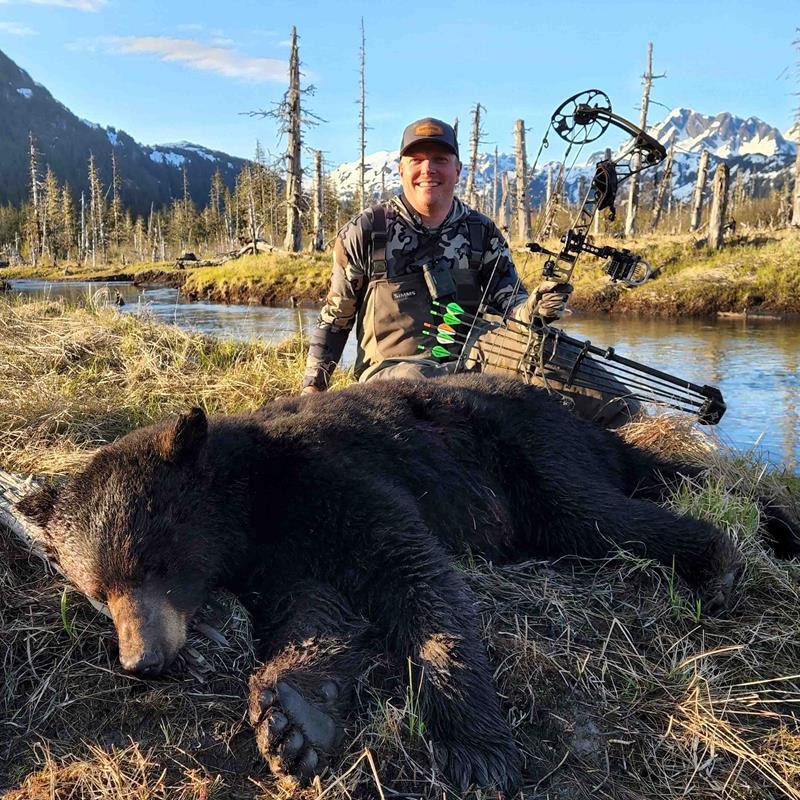
Each year, it seems someone here in the office is hunting predators somewhere. Give us a call if you have any
questions on planning your next hunt. We work with a number of outfitters across the western United States. Although the waiting list may be long depending on your desired adventure, it never hurts to start planning now with one of our Huntin’ Fool Adventures Advisors.
ALASKABROWN BEAR/GRIZZLY BEARA guide is required. With the exception of one registration hunt area near the city of Kodiak, all bear permits on Kodiak Island are regulated entirely within a draw system for residents and non-residents. Applicants must have a guide-client agreement signed prior to applying, and the outfitter will submit your application for you with their unique UVC code. Draw odds may be up to 100% as the outfitter will select who will be applied based on their hunt booking schedule and will not flood their own drawing. Prospective applicants should look at Kodiak with a “guide-first” approach. Guided Kodiak bear hunt prices range from $20,000 to $45,000.South of the Boone & Crockett boundary line, hunters will find themselves with plenty of options to hunt brown bear. A registered guide or resident-relative is required for all non-residents. Hide condition, hunting style, and vegetation play a huge part in differentiating one hunt from another. Those looking at an extreme hunt with a chance at a 9'+ bear will most likely look to the Alaska Peninsula. This management unit offers an open registration permit system for all brown bear permits. The spring and fall seasons alternate each year, meaning even years have a spring season (May) and odd years have a fall season (October). Hunters may only harvest one brown bear every four regulatory years in this unit. Guided hunts range from $24,000 to $38,000, with most reputable outfitters being booked two to four years in advance. Outside of Kodiak Island or the Peninsula, brown bears can be hunted in the southern portion of the state. Many times, these hunts can potentially be combined with moose, Dall sheep, or caribou on a trophy fee basis.Keep in mind that Alaska does not distinguish hunts between subspecies of brown/grizzly bears. The bag limit set statewide is for “brown/grizzly bear” and utilizes the same locking-tag required for non-residents to purchase before the hunt. This means that you are subject to the same bag limit per regulatory year and could not harvest two brown/grizzly bears in the same regulatory year (July 1-June 30) if the bag limit is one bear. Some units allow for up to two bears being taken each regulatory year. It is up to the hunter to keep track if they have met the current bag limit. Some brown bear areas only allow one bear to be taken every four regulatory years. Alaska’s harvest and permit system will not keep track of this bag limit for you, so make sure you have your own records clean and organized!BLACK BEARAlmost all units in Alaska continue to offer non-resident seasons for black bear with year-round seasons. Bag limits range from one to up to five bears per regulatory year. Keep in mind that a regulatory year is July 1-June 30. You may not take a bear in the fall and expect to be able to hunt the following spring as well if that unit has a bag limit of one bear. Remember, a guide is not required to hunt black bear anywhere in Alaska. The three units that require unguided non- residents to apply and draw a permit in order to hunt are in the southeast portion of the state. These hunts continue to be draw only to limit the non-resident hunting pressure on the area and preserve the opportunity for the local outfitters, most of which are boat based. Keep in mind that you cannot draw the exact same permit (hunt code) two years in a row, even if you do not use the permit the first year.WOLFWolves are found throughout mainland Alaska, on Unimak Island in the Aleutians, and on most of the major islands in the southeast. Alaska is home to an estimated 7,000 to 11,000 wolves. The highest densities occur in Southeast Alaska where Sitka blacktail deer serve as the major food source for wolves. Wolf densities are lowest in the coastal portions of Western and Northern Alaska. Although the distribution of wolves has remained relatively constant in recent times, their abundance is influenced by harvest levels, diseases, and prey availability. A majority of units allow you to take up to five wolves within the season, in some areas such as unit 10 the Aleutian Islands, per day. A locking-tag is not required in units 1, 3, 9, 10, 12, 13, 15–17, 19–21, and 24–25. Hides must be sealed within 30 days of kill. Wolves may also be taken with a trapping license during trapping season.Some of your best options for wolf hunting still lie in Alaska and Canada. If you are going up north on a hunt for another species, most outfitters will let you harvest a wolf on a small trophy fee. You may also book a wolf- only hunt, which will cost between $5,000 and $6,000 with an extensive waitlist. We work with outfitters that offer all types of wolf hunts. Typically, wolf hunts in Canada and Alaska have higher hunter success than the lower 48 wolf hunts. If you would like more information on hunts up north or if you are looking for an Endorsed Outfitter, give us a call.
ARIZONABLACK BEARArizona is pretty wide open when it comes to hunting black bears. Each unit is controlled by season dates as well as a female harvest limit. When the female harvest is met, the unit is shut down. Spring bear starts at the end of March and runs to the end of April, while fall bear hunting starts in the month of August and then runs from October to December. There are a few archery-only permits open inselect units there in between. Only one bear per hunter may be taken per calendar year. Within 10 days of taking a bear, hunters must present a skull and hide with proof of sex to an AZGFD employee. The use of dogs is legal, but it is prohibited during bear hunts from January 1st
to July 31st.MOUNTAIN LIONTo hunt mountain lions in Arizona, you need a valid hunting or combination license and a mountain lion tag. For harvest quota, units are clustered into zones labeled A, B, C, etc. Each corresponding zone will have its own harvest quota. Unlike black bears, there is not a specific annual female harvest threshold. The percent of total and adult females in the annual harvest by management zone will be monitored to determine if harvest thresholds should be adjusted. Season dates for mountain lion are pretty open, ranging from the end of August until the end of May. Your bag limit is one mountain lion percalendar year. Mountain lion harvest must be reported online within 48 hours, and hunters must present a skull and hide with proof of sex to an AZGFD employee within 10 days of taking a lion.
CALIFORNIACalifornia rarely gets brought up in a bear hunting conversation, which is unfortunate because it is home to some great bear hunting! Maybe it is because it is the fall season. Bear tags are issued over-the- counter on a harvest quota basis. Ever since California banned the use of dogs for bear hunting, the quota of 1,700 has not been met. Any cub or sow accompanied by one or more cubs is illegal to harvest. If you kill a bear, you must have the tag countersigned (validated) by a CDFW employee. Bear tags must be validated prior to transporting the bear, except for the purpose of taking it to the nearest person authorized to validate the tag en route to your home from the point where the bear was taken.The archery bear season starts in the middle of August and runs through the first week of September. The general rifle season opens concurrently with the general rifle deer hunting seasons in zones A, B, C, D, X8, X9A, X9B, X10, and X12 and extends through the end of December. The remaining deer X zones open in the middle of October and extend through the end of December. All seasons will close early if CDFW reports 1,700 bears being taken. All harvested bears must have a validated bear tag before transportation. Whether or not you are successful, all bear tags must be returned to the CDFW no later than February 1, 2025.
COLORADOBLACK BEARMuch like California, all of Colorado’s bear hunting will take place in the fall. All of the bear seasons follow along with the rest of the big game season structure, i.e. archery, muzzleloader, and 1st-4th
rifle. However, when it comes to bear, there are some additional seasons thrown in such as a September rifle season as well as a Plains rifle season that starts in September and runs through the end of November. There are two ways to get a bear permit in Colorado. You can draw the tag/pick up a leftover, or you can purchase an over- the-counter permit. The only caveat to the OTC permit is that you can purchase an add-on over-the-counter archery, muzzleloader or rifle bear license only if you have a deer or elk license for the same method of take. The units that are available are listed in the big game brochure, both under the Bear section of the regs as well as identified by a bear paw symbol by the deer and elk hunt code tables.MOUNTAIN LIONYou may take one mountain lion, either sex, per license year (April 1–March 31). Hunters may harvest one lion in the month of April or one lion during the fall season, which starts at the end of November and runs until the end of March the following year, depending on the valid season dates for the unit you are hunting. Not every unit is open for both sets of season dates. Furthermore, each hunting unit has its own total harvest limit. You must check daily to make sure the unit you want to hunt is open. Units close when harvest limits are reached. It is illegal to hunt (pursue or harvest) a mountain lion in a unit after it has closed. Dogs are permitted in Colorado and possess their own set of limitations.
IDAHOBLACK BEARThere are very few controlled (draw) bear tag options in Idaho, including spring season, fall season, and a youth-only hunt. Other than the less than 10 hunt options for controlled hunt periods, the rest of the state is wide open for general bear hunting. You will need to pay attention in your planning to your specific zone as each unit has multiple variants such as season dates, dates, when/if dogs are prohibited, and what units you can use a second bear tag in. Unfortunately, there is not a really easy way to sum up the dates, but most units will have a spring season from April to June and a fall season from October to November.All persons placing bait must possess a baiting permit issued by Fish and Game. Baiting permits are issued by mail or in person at Fish and Game offices beginning March 1st
of each year. Baiting permits will be valid in the calendar year for which they are issued. A hunter may possess only one Fish and Game baiting permit each year and may maintain up to three bait sites.MOUNTAIN LIONAs a whole, the mountain lion season in Idaho is wide open! The only variants throughout the year (July-June of the following year) are various regulations, such as the use of dogs, electronic calls, and units that you can fulfill a second mountain lion permit. The basic gist is that you can use one full-priced mountain lion tag in any general season unit in the state. Your reduced-price mountain lion tags can only be used in units that allow second lion tags. The units have the chance to vary, so the best thing to do is to check the unit tables each year listed in the big game regulations. A hunter may use an unfilled non-resident deer or elk tag to take instead a black bear, mountain lion, or gray wolf during the open season corresponding to the deer or elk tag hunt area or unit when the season for the animal taken is also open.WOLFIdaho has a large wolf population, estimated at just over 1,300 wolves. Tons of public land and unlimited, inexpensive wolf tags make Idaho a perfect wolf hunting destination. There are no individual unit harvest quotas in place, so licensed hunters can hunt statewide within season dates. Idaho allows year-round trapping for wolves on private property. Currently, wolf trapping seasons in 19 Idaho counties are closed due to a lawsuit in federal court.Special wolf seasons allow for expanded methods of take. These include weapon restrictions that do not apply to wolf hunting, exemption from shooting hours, and allowance for spotlight or night vision equipment. Written permission from the landowner is required on private land, and a permit from the Director of Fish and Game is required on public land, which is consistent with requirements for spotlighting coyotes at night. Hunting wolves over bait is allowed on private land with landowner permission. Motorized vehicle restrictions for hunting big game do not apply for wolf hunting. Dogs may be used to pursue wolves, and no hound hunter permit is required.Wolves can be found almost anywhere throughout Idaho, with higher concentrations in the northern and central regions of the state. This is especially true in GMUs 1 and 4, which combined, account for around 25% of Idaho’s statewide wolf harvest each year. In the northern Panhandle, you will be hunting logging areas as well as some thickly-timbered mountains. A lot of wolves are harvested each year by hunters who are in the field hunting other big game. Most hunters going to Idaho after wolves typically go December through February.
MONTANABLACK BEARIn true Montana fashion, there is a huge opportunity to hunt black bears. A hunter may purchase only one black bear license per year. A free Black Bear Identification Test Certificate is required to obtain a license. The spring season starts in the middle of April and goes until the middle of June. There will be an archery-only season the first part of September as well as a fall bear season that goes from the middle of September until the first of December. Beyond the season structure, there are options that vary not only from region to region but bear management unit to bear management unit. The biggest variation is during hound hunting season, as a rule of thumb, as it’s only during spring season, but beyond that, you will have to check each unit in the regulations to see if hound hunting is available.MOUNTAIN LIONIn Montana, non-residents may hunt a mountain lion with one of the following three license options – Restricted OTC Mountain Lion License (archery season and fall season without dogs), Limited Mountain Lion License (limited to 10% of the quota or less), or Unlimited Mountain Lion License. Applicants must possess a current year conservation license and a base hunting license to apply for or purchase any mountain lion license. A hunter may purchase only one mountain lion license per year. An unlimited mountain lion license is valid until the quotas are filled or the season is closed, whichever occurs first, and is only valid in the region, LMU, or group of LMUs specified on the license. Each unit has its own harvest limit. Archery season without dogs is the beginning of September until the middle of October. Fall season without dogs is from the end of October until the beginning of December. And the big season, the winter season, goes from the beginning of December until the middle of April.WOLFTypically, Montana averages 250-300 wolves taken each year. Montana Fish, Wildlife, and Parks estimates there to be 1,087 wolves statewide. Most of the wolves in Montana are found on the western portion of the state in regions 1-3. The majority of the wolves harvested each year are by trappers or hunters pursuing elk and deer during the general season in Western Montana. Non-resident hunters holding a deer or elk combination license will pay $25 for their first wolf tag. All other wolf tags will be $50 per wolf license. Non-resident hunters and trappers may harvest any wolf in any open WMU or region statewide during the archery-only, general, and trapping seasons. A person can take up to 20 wolves withno more than 10 via hunting and no more than 10 via trapping (maximum harvest of 20 wolves per person). The season dates for wolf hunting are as follows – archery season is the first two weeks of September, and the general rifle season is the middle of September until the middle of March the following year.
NEVADABLACK BEARBoth black bear and mountain lion are pretty straight forward in Nevada. There are 10 units with three-unit groups open to black bear hunting by draw permit only – 192, 194, 195, and 196; 201, 202, 204, and 206; 203 and 291. There is a set total harvest per unit group as well as female harvest, and units will stay open from the middle of September until the first of December or until the harvest limits are met.MOUNTAIN LIONMuch like black bear, really straight forward mountain lion permits are valid statewide except units 033, 269, 280, 281, 282, 283, 284, and 286. The season begins March 1
st each year and will go until the last day of the next February or when the number of harvested mountain lions reaches the quota limit, whichever happens first.
NEW MEXICOBLACK BEARAn OTC bear license is required to hunt bears in New Mexico, including to validate a draw permit. There are a total of seven draw permits, and of those, three are available to residents only, one bow only, and one youth only. The rest of the state is OTC. The bag limit is one bear. New Mexico is divided into Bear management zones, enabling NMDGF to better manage regional bear populations. Each zone has two harvest limits – the total number of bears that may be harvested and the number of female bears that may be harvested. Bear management zones close when harvests reach 90% of the total limit, 90% of the female limit, or when the season has ended, whichever occurs first. Hunt dates vary from zone to zone, with most having an archery hunt in August/September and a rifle hunt that goes from September until November. Be sure to check your zone for four things – dates, weapons, use of dogs, and harvest quota – as all four of those are very volatile in New Mexico.MOUNTAIN LIONIn New Mexico, mountain lion permits are available over-the-counter and must be purchased at least two calendar days before hunting. Individual bag limit is two permits. The season runs from April 1st
until March 31st
of the following year. New Mexico is divided into 18 management units, and each management unit has a total harvest limit and a female harvest limit. Cougar management zones will close and hunting will cease when harvests reach 90% of the total limit, 90% of the female limit, or when the season has ended, whichever occurs first.
OREGONBLACK BEARAt most, a hunter may obtain one controlled spring black bear tag, one general season fall black bear tag, and one additional fall black bear tag. All spring bear hunts are controlled hunts and are issued through the draw. Spring season runs April 1st
through May 31st. The statewide fall season goes from August 1st
and goes until December 31st. The use of bait and using dogs to hunt or pursue black bear is prohibited.MOUNTAIN LIONAt most, a hunter may obtain one general season cougar tag and one additional general season cougar tag. Cougar tags are statewide and are for the whole calendar year, January 1-December 31. Each zone/ management area has a harvest quota. If the quota is met, the cougar zones will be closed. However, quotas are typically not met. Using dogs to hunt or pursue cougar is prohibited.
UTAHBLACK BEARTo participate in Utah’s black bear hunt, you need to obtain a permit. The Division distributes permits for limited-entry hunts and restricted pursuit through the black bear drawing. You may not apply for or obtain more than one permit to harvest a black bear in 2024. You can, however, obtain a bear pursuit permit in addition to a limited-entry or harvest-objective permit. There are three different types of bear hunting permits in Utah, including limited-entry permits. These permits are available for any legal weapon hunts. If you obtain one of these permits, it authorizes you to harvest one black bear in the area and season specified on your permit. Multi-season limited-entry permits authorize you to use any legal weapon to harvest one black bear in the area and multiple limited- entry seasons specified on your permit. You must use the appropriate weapon type and method for the seasons you are hunting. For harvest-objective permits, biologists have set harvest objectives (quotas) for the number of bears that can be taken on certain units. When the objective is met, the unit closes to bear hunting for the rest of the season. The harvest-objective permit allows you to use any legal weapon to harvest one bear on any harvest-objective hunting unit until the season ends or the unit’s harvest objective has been met.The spring limited-entry hunts on specific units start the end of March and go until the end of May. No baiting is allowed. The summer limited-entry hunts go from the end of May and go until the end of June. No dogs are allowed. The fall limited-entry hunts have multiple season dates, first the month of August and then the first week of November. No baiting is allowed. There is one limited-entry spot and stalk-only hunt currently in the Book Cliffs and it goes from September until November. Unfortunately, it is a resident-only hunt. Your over-the-counterhunts (harvest-objective) encompass a wide option of units across the state. These units all have erring harvest quotas, season dates, as well as bait/dog hunting methods that are clearly outlined in the bear guidebook.MOUNTAIN LIONCougars can now be harvested year- round with a valid hunting or combination license. A bag limit and the requirement for a permit have been removed. You can also trap cougars now as well, following current trapping rules and guidelines. You will still need to salvage the pelt and skull of the harvested cougar and cannot allow those parts of the animal to waste. However, the code change does not change the classification of cougars as protected wildlife in Utah. Harvested cougars will still need to be checked in at a DWR office or to a DWR employee within 48 hours of harvest to report it and receive a permanent possession tag. Biologists will monitor harvest rates and determine the effects of this new hunting strategy.
WASHINGTONBLACK BEARThere is no spring season for black bear in Washington, but you can hunt black bears in the fall from the beginning of August until the middle of November. GMUs 157, 490, and 522 are closed to fall bear hunting. A current special deer or elk permit is required to hunt bear in GMU 485. A valid big game hunting license includes black bear as a species option. A second black bear transport tag/license must be purchased to take a second bear. Hunters may purchase a maximum of two black bear transport tag/ licenses. Two black bears can be harvested during the license year. Hunters may use any legal weapon for hunting black bear. Bait or hounds are not allowed for bear hunting.MOUNTAIN LIONThe hunting season for mountain lion starts the beginning of September and runs until the end of March or until the harvest cap is met. The cap for each hunt area is set at the intrinsic growth rate of 13%. If a hunt area reaches its cap in all known human- caused mortalities before the season opens on September 1st, the hunt area cap extends to 20%. Once the assigned cap is reached for each hunt area, it will close to cougar harvest. All known human-caused mortalities will be counted towards the cap from April 1st
to March 31st. The statewide bag limit is one cougar per license year. A transport tag is included with a big game hunting license that has cougar as a species option. Hunters can use any legal weapon for hunting cougar. The use of dogs for recreational hunting of cougar is prohibited statewide.
WYOMINGBLACK BEARThe black bear hunting season shall close in each black bear hunt area or group of hunt areas when the female mortality limit specified for the respective hunt area or group of hunt areas has been reached. The season dates in Wyoming vary immensely by season and weapon type. There will be a spring archery April 15-30 followed by a spring rifle May 15-June 15. In the fall, the archery season varies with both August and September start dates, and the rifle is no cleaner with hunts starting in August, September, and October. The biggest thing when hunting black bear in Wyoming is making sure the area you are hunting has not met the annual female mortality limit. You may only have one permit per calendar year.MOUNTAIN LIONThe mountain lion season runs from September 1st
until March 31st
in most cases. There are a few outliers. Each hunt area has its own set mortality limit that will close that hunt area. There are three areas currently that allow for an unlimited number of cats to be harvested and one that has a resident/ non-resident split for mortality. The only areas in the state you can use a reduced- price mountain lion permit are areas 5, 7, 8, 9, 15, 16, 19, 24, 25, 27, and 31. A hunter may receive a maximum of one full-priced mountain lion license and a maximum of one reduced-priced mountain lion license per calendar year.WOLFThe wolf hunting seasons inside the Trophy Game Management Area will run September 15-December 31 for all areas except 12 and 13. Unit 12 will run October 15-December 31, and unit 13 will run September 15-March 31. Wolves will continue to be treated as predators in the Predatory Animal Management Area where there is no season and no license needed to harvest. There are 14 wolf units inside the management area with set quotas for each one. Once the individual unit quotas are met, the season will close in that specific unit.Wyoming Game and Fish’s most recent count shows a minimum of 314 wolves in 40 packs living in Wyoming. Hunters may harvest one permit per calendar year January-December. A hunter may purchase up to two gray wolf licenses per any one calendar year. Wyoming’s wolf tags are expensive, but if you are planning on hunting Northwest Wyoming, it may be worth buying one if the quota is still open in the areas you plan on hunting. Unfortunately for non-resident hunters, there is a lot of wilderness in the northwest portion of the state. A non-resident cannot legally hunt in the wilderness unless they have an outfitter or are accompanied by a Wyoming resident.