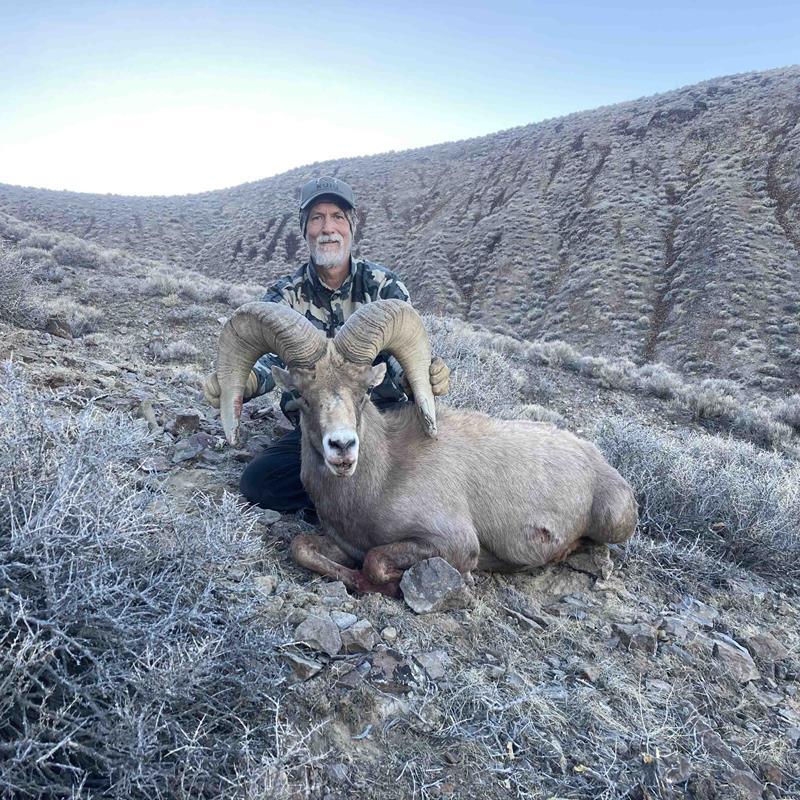
I received word in mid-February that my 2023 Desert bighorn sheep would qualify for the Nevada Wildlife Record Book. I reflected on my trip and also how my sheep hunting had started here in Nevada in 1989. I had drawn a Stonewall Mountain Desert bighorn sheep tag in 1989 on my third year applying. I knew nothing about hunting sheep, but it was another opportunity to be outdoors. My dad and I did a self-guided hunt. I took my ram from a group of seven late on the fifth day. When I found my ram, right at dark, a feeling that I had never felt came over me. This was special! The next day, Thanksgiving Day, my dad and I packed the ram o? the mountain. My dad told me, “If you want to hunt like this, go while you can.”
The following January, I attended the F.N.A.W.S. (now Wild Sheep) Convention. I soon learned about the other North American wild sheep and how fortunate I was to have gotten my Desert ram as it was the hardest of the four to get at the time. Over the last 34 years, I have had the opportunity to go on 14 North American sheep hunts (six of them on draw permits) and taken 12 rams. With the popularity of sheep hunting and a very limited resource, the chance of drawing a tag is very small. With that in mind, I was considering not applying due to a very full fall 2023 hunting schedule, but then I thought, what if this was the year? What a surprise when I was awarded my second Desert bighorn sheep tag!
My fall travel schedule was full from early August to mid-November with only a couple of weeks total time in between trips, leaving virtually no time to scout pre-season. I contacted my friend, Keith Montes, for assistance. Late September, Keith indicated he would like to be hunting opening day.
I showed up at our prearranged camping site three days prior to opening day. I met Mike and his friend, Tom. They had seen a few sheep earlier in the day. That afternoon, we saw another 20 sheep. The next day, we found two really good rams along with quite a few ewes and lambs. Late that same day, two of Mike’s friends, Kevin and his son Cameron, arrived to help out. The day before the opener, we found two more groups of rams – two large rams in a group of 5 and one large ram in a group of 10. We again saw the two rams from the day before, and the largest one appeared to have broken o? part of his left horn.
The night before the season opener, we all had a discussion on where to go first thing in the morning. Ultimately, I liked the two rams in the group of five as either ram was a shooter in my opinion. We decided to arrive about an hour before sunrise, and if someone else was already in position to find them, then we would go after the other ram in the group of 10 as they were in a much more remote spot.
We arrived at our chosen location, and no one else was there. It was a crisp 18 degrees and clear. A perfect start. As the sun began to appear on the eastern horizon, Mike, Tom, Kevin, Cameron, and I began to stir. It was not long before we spotted the two rams from the morning before. We watched for a little while when suddenly one of the rams started walking down the ridge to the bottom of the draw and up the other side to join a band of ewes and lambs. The other ram stayed with three ewes. Not long after, a caravan of multiple vehicles with two large horse trailers came up the road. They stopped, and one of the drivers approached us. He was working for the Bureau of Land Management and informed us they would be conducting a wild horse roundup in a couple of hours using a helicopter. On opening day of sheep season, great! We decided that we had better get going and approach the sheep as we were about a mile away. Once there, we would decide what to do.
Mike, Kevin, and I donned our packs and o? we went. Once at the base of the mountain, we lost sight of the sheep. We carefully ascended a ridge where we spotted the one ram with three ewes bedded down at 650 yards away. Kevin set up the spotting scope, and we got a real good look at this ram. He was heavy, carried his mass well, and was well broomed o?. He appeared older, and I was able to age him at nine. Definitely a ram I would take. He was in a good spot for him and not for us. Mike, Kevin, and I agreed we should also get a look at the other ram before making a final game plan.
We eased up the ridgeline to where we had seen the sheep last. Once at the top, we stopped and glassed. No sheep. After a while, the helicopter showed up, flying right over the top of us. Immediately after, sheep started to move. First the ewes and small rams. Finally, the larger ram appeared, walking along with the rest of the band. Unfortunately, they had moved across the canyon on the other side of a ridge extending down from the top between us. They were working their way to the top and were in and out of sight. This ram was virtually the same as the first ram and maybe a little longer. I decided to set up for a longer shot. Unfortunately, I missed. The ram moved behind the ridge, and we never saw him again.
We thought he went out over the top, so we worked our way around the ridge to the saddle leading to the next canyon. On the way there, we could see the first ram. He and his ewes had moved lower into the bottom of the draw they were in originally, not moving very far. We continued into the next canyon. We cut a main trail, and it was covered with sheep tracks. It appeared our band had gone over into the next canyon through the saddle. We spotted and moved. No sheep. We decided to keep climbing and spotting. Just o? the very top, we spotted a band of bedded sheep. We could see the top of what appeared to be a larger ram. Was this the one we had seen and missed earlier? I put a sneak on to about 200 yards and set up for a shot. I waited an hour before the ram rose. Not our ram!
It was now late afternoon. We started our still hunting again. As we worked our way around the top of the mountain, we began to approach the area where we had last seen the first ram with the three ewes. As we eased along, we spotted all four sheep up and feeding. We got another real good look at the ram at about 500 yards. I confirmed what I had seen in the morning. This was a good ram, and I liked him! We evaluated the situation, and we had two choices. One approach was faster but much riskier due to wind, noise, and sun. I opted for the longer approach. We would have to back rack, make a long, steep descent, and then sidehill to a small saddle just above the feeding sheep with the wind in our faces and the sun at our backs.
O? I went since I was the older and slower one. Once to the saddle, we dropped our packs and caught our breath. We began to still hunt along the ridge above the area we had last seen the feeding sheep. We still hunted to within 50 yards of the sheep when one of the ewes saw us. They moved down the slope and came up the other side of the draw, stopping at 200 yards. I centered my scope on the ram and touched the trigger. I hit him but was not sure how well as he wheeled and started running down the draw. I chambered another round and shot again. This one also hit him, and within two to three steps, the ram collapsed and rolled down the hill, stopping about 50 yards from the bottom. I had just taken my second Nevada Desert bighorn ram.
As we approached the old warrior, I took in the whole experience for a second time. Thirty-four years ago, I had approached my ram by myself. This time around, I was able to share the experience with new friends. My ram was everything I thought he was. Heavy, carried his weight well, was well broomed, had a scarred up nose, and was old.
At the check-in with the Department of Wildlife, they aged my ram at 11 years old. He had battled other sheep and avoided mountain lions for over a decade. I was truly blessed and proud to have taken this old warrior.
The following January, I attended the F.N.A.W.S. (now Wild Sheep) Convention. I soon learned about the other North American wild sheep and how fortunate I was to have gotten my Desert ram as it was the hardest of the four to get at the time. Over the last 34 years, I have had the opportunity to go on 14 North American sheep hunts (six of them on draw permits) and taken 12 rams. With the popularity of sheep hunting and a very limited resource, the chance of drawing a tag is very small. With that in mind, I was considering not applying due to a very full fall 2023 hunting schedule, but then I thought, what if this was the year? What a surprise when I was awarded my second Desert bighorn sheep tag!
My fall travel schedule was full from early August to mid-November with only a couple of weeks total time in between trips, leaving virtually no time to scout pre-season. I contacted my friend, Keith Montes, for assistance. Late September, Keith indicated he would like to be hunting opening day.
I showed up at our prearranged camping site three days prior to opening day. I met Mike and his friend, Tom. They had seen a few sheep earlier in the day. That afternoon, we saw another 20 sheep. The next day, we found two really good rams along with quite a few ewes and lambs. Late that same day, two of Mike’s friends, Kevin and his son Cameron, arrived to help out. The day before the opener, we found two more groups of rams – two large rams in a group of 5 and one large ram in a group of 10. We again saw the two rams from the day before, and the largest one appeared to have broken o? part of his left horn.
The night before the season opener, we all had a discussion on where to go first thing in the morning. Ultimately, I liked the two rams in the group of five as either ram was a shooter in my opinion. We decided to arrive about an hour before sunrise, and if someone else was already in position to find them, then we would go after the other ram in the group of 10 as they were in a much more remote spot.
We arrived at our chosen location, and no one else was there. It was a crisp 18 degrees and clear. A perfect start. As the sun began to appear on the eastern horizon, Mike, Tom, Kevin, Cameron, and I began to stir. It was not long before we spotted the two rams from the morning before. We watched for a little while when suddenly one of the rams started walking down the ridge to the bottom of the draw and up the other side to join a band of ewes and lambs. The other ram stayed with three ewes. Not long after, a caravan of multiple vehicles with two large horse trailers came up the road. They stopped, and one of the drivers approached us. He was working for the Bureau of Land Management and informed us they would be conducting a wild horse roundup in a couple of hours using a helicopter. On opening day of sheep season, great! We decided that we had better get going and approach the sheep as we were about a mile away. Once there, we would decide what to do.
Mike, Kevin, and I donned our packs and o? we went. Once at the base of the mountain, we lost sight of the sheep. We carefully ascended a ridge where we spotted the one ram with three ewes bedded down at 650 yards away. Kevin set up the spotting scope, and we got a real good look at this ram. He was heavy, carried his mass well, and was well broomed o?. He appeared older, and I was able to age him at nine. Definitely a ram I would take. He was in a good spot for him and not for us. Mike, Kevin, and I agreed we should also get a look at the other ram before making a final game plan.
We eased up the ridgeline to where we had seen the sheep last. Once at the top, we stopped and glassed. No sheep. After a while, the helicopter showed up, flying right over the top of us. Immediately after, sheep started to move. First the ewes and small rams. Finally, the larger ram appeared, walking along with the rest of the band. Unfortunately, they had moved across the canyon on the other side of a ridge extending down from the top between us. They were working their way to the top and were in and out of sight. This ram was virtually the same as the first ram and maybe a little longer. I decided to set up for a longer shot. Unfortunately, I missed. The ram moved behind the ridge, and we never saw him again.
We thought he went out over the top, so we worked our way around the ridge to the saddle leading to the next canyon. On the way there, we could see the first ram. He and his ewes had moved lower into the bottom of the draw they were in originally, not moving very far. We continued into the next canyon. We cut a main trail, and it was covered with sheep tracks. It appeared our band had gone over into the next canyon through the saddle. We spotted and moved. No sheep. We decided to keep climbing and spotting. Just o? the very top, we spotted a band of bedded sheep. We could see the top of what appeared to be a larger ram. Was this the one we had seen and missed earlier? I put a sneak on to about 200 yards and set up for a shot. I waited an hour before the ram rose. Not our ram!
It was now late afternoon. We started our still hunting again. As we worked our way around the top of the mountain, we began to approach the area where we had last seen the first ram with the three ewes. As we eased along, we spotted all four sheep up and feeding. We got another real good look at the ram at about 500 yards. I confirmed what I had seen in the morning. This was a good ram, and I liked him! We evaluated the situation, and we had two choices. One approach was faster but much riskier due to wind, noise, and sun. I opted for the longer approach. We would have to back rack, make a long, steep descent, and then sidehill to a small saddle just above the feeding sheep with the wind in our faces and the sun at our backs.
O? I went since I was the older and slower one. Once to the saddle, we dropped our packs and caught our breath. We began to still hunt along the ridge above the area we had last seen the feeding sheep. We still hunted to within 50 yards of the sheep when one of the ewes saw us. They moved down the slope and came up the other side of the draw, stopping at 200 yards. I centered my scope on the ram and touched the trigger. I hit him but was not sure how well as he wheeled and started running down the draw. I chambered another round and shot again. This one also hit him, and within two to three steps, the ram collapsed and rolled down the hill, stopping about 50 yards from the bottom. I had just taken my second Nevada Desert bighorn ram.
As we approached the old warrior, I took in the whole experience for a second time. Thirty-four years ago, I had approached my ram by myself. This time around, I was able to share the experience with new friends. My ram was everything I thought he was. Heavy, carried his weight well, was well broomed, had a scarred up nose, and was old.
At the check-in with the Department of Wildlife, they aged my ram at 11 years old. He had battled other sheep and avoided mountain lions for over a decade. I was truly blessed and proud to have taken this old warrior.