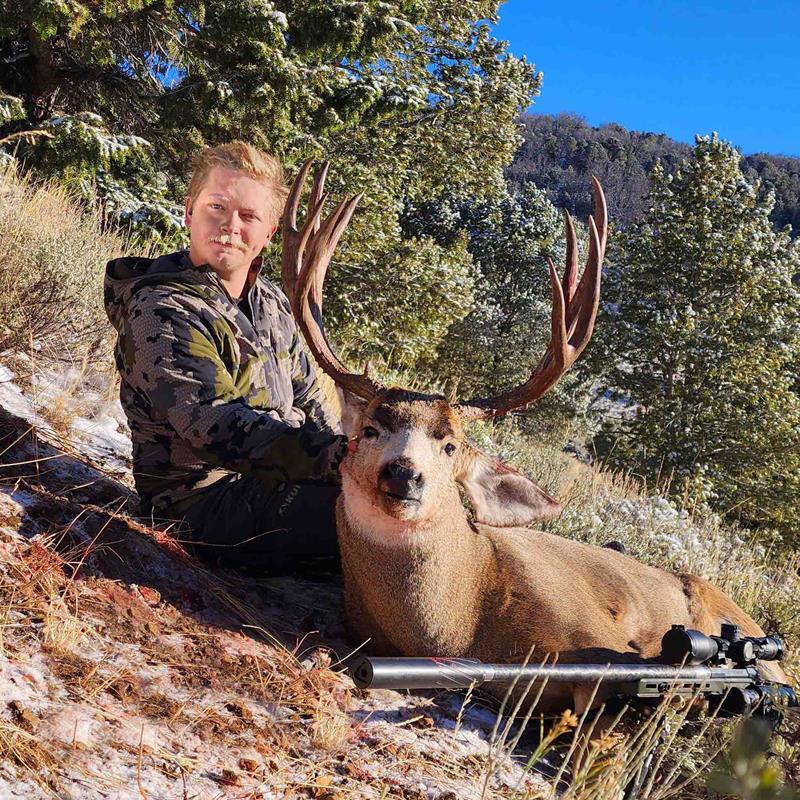
A Harsh Weather Battle for a Late-Season Mule Deer Harvest
In 2024, I drew my first out-of-state tag for Idaho mule deer. It was pre-rut in a high country unit with an extremely low deer population. With a three-week long season and only a week to hunt it, I waited for the snow and cold in the forecast during the second week in hopes it would draw the elusive mid-October mule deer out of their hidey holes.
On day one with 6" of snow and 12-18" drifts, I packed my camp several miles to the head of a canyon I’d hunted with others in past seasons. I set my one-man Summit Star KUIU tent up on a steep, rocky spine with a herd of 40 elk bedded on the ridgetop, a bugling bull 700 yards away, and a group of bighorns just 50 yards below. The camp location was perfect, only needing to walk 300 yards to glass all I needed to see.
For three days with temperatures in the teens at night and into the mornings, I sat first light to last light with my eyes stuck to my 12x50 Vortex Razor UHDs and spotting scope any time I had visibility between the harsh wind, blowing snow, and fog. Spotting a lot of bighorn sheep and rutting elk every day and only a handful of mule deer, the only notable one was a super narrow but tall with good forks 140s class buck at 150 yards. It was higher than both the elk and bighorns. Going into the hunt, I was set on 160"+ or an old, nasty troll like we had killed the year prior. It was a 13+ year old 141" 3x3.
Knowing that the later in the season it gets, the more likely a buck might show itself, I left the basin with sunburned eyes and a wind-burned face. A week later, I returned to the much higher and steeper opposite side of the canyon for one and a half days, setting my tent atop a narrow, rocky spine at nearly 11,000 feet with a large group of mountain goats keeping me company. Glassing for two evenings and a morning and finding only three deer (a bachelor group of 2 to 3-year-old bucks) and many more bighorn, goats, and elk, I retreated off the mountain, nearly being blown off my feet by the wind every step of the way down.
The next day, I found myself at the bottom of the drainage glassing up at where I had camped previously. The worst fog of the hunt was rolling in and only giving me visibility to glass for 30 minutes that day. Confident I had seen most of the deer in the drainage, I crossed the area off the list for the remainder of the hunt.
With just three days left in the season, I regrouped, resupplied, and headed into a brand new area for the remainder of the hunt. I was loaded heavy with a plan in mind to move camp to new glassing points every night. Mid-afternoon, I ascended to the windy, snowy ridgetop where I planned to camp the first night. Despite the limited visibility, I was able to glass up dozens of bull elk already bachelor herded up, prepared for the winter. As I was preparing to make my first camp and glass the remainder of the evening, I spot three deer. They were three bucks nearly three miles away. So far away and with snow coming down, all I could see was the frame of his antlers and a big body.
With two and a half hours left in the day, I went as fast as my lungs allowed down 1,200 feet and up 800 feet to an opposing ridge across from where I had seen the deer. With 30 minutes of light left, a nice buck appeared just 400 yards away. It was a good buck in the 150s class but young. With a perfect view of the hillside the deer were on, I set up my tent right there, making a fire to warm before crawling into the tent for the night.
The next morning, I awoke to frozen boots. I wiggled my feet back and forth for minutes until I could finally push them on. Being camped where I saw the deer the night before, I only had to walk 50 yards to start my morning hunt. As light grew, I could see a few deer just where I had left them. Waiting on more light, I started identifying them. There were the same three, the 150s buck and two smaller bucks. To my surprise, there were some does towards the top. Suddenly, a big, blond body started bouncing down the hill towards the three bucks. Just seeing the mass, I knew he was a shooter, but he quickly went out of sight from where I lay. I grabbed my rifle and ran 100 yards closer. As I neared where I thought he would be, I looked up and the buck was already going back up the ridge towards the does. I dropped to the ground and ranged quickly. 430 yards. I dialed the .338 RUM, and as he slowed to a stop getting close to the does, he presented a quartering angle. I sent the 270 grain ELDX through his shoulders, dropping him on the spot, not knowing exactly what I had just killed.
As I sidehilled over to where I believed him to be, I saw one of his giant back forks glistening and sticking out of the sage. As I walked up, it became real. All the time spent glassing and enduring through the elements, seeing far more sheep and goats than deer was worth it. My biggest buck was a heavy, truly old 4x5 chocolate-horned beast. Being solo, I deboned and caped the deer. Once I arrived at my camp, I was able fit it all on my KUIU pack. More than doubling the weight I started the hunt with, I hiked two and a half brutal miles out, losing 2,000 feet of elevation to a closer trailhead for pickup.