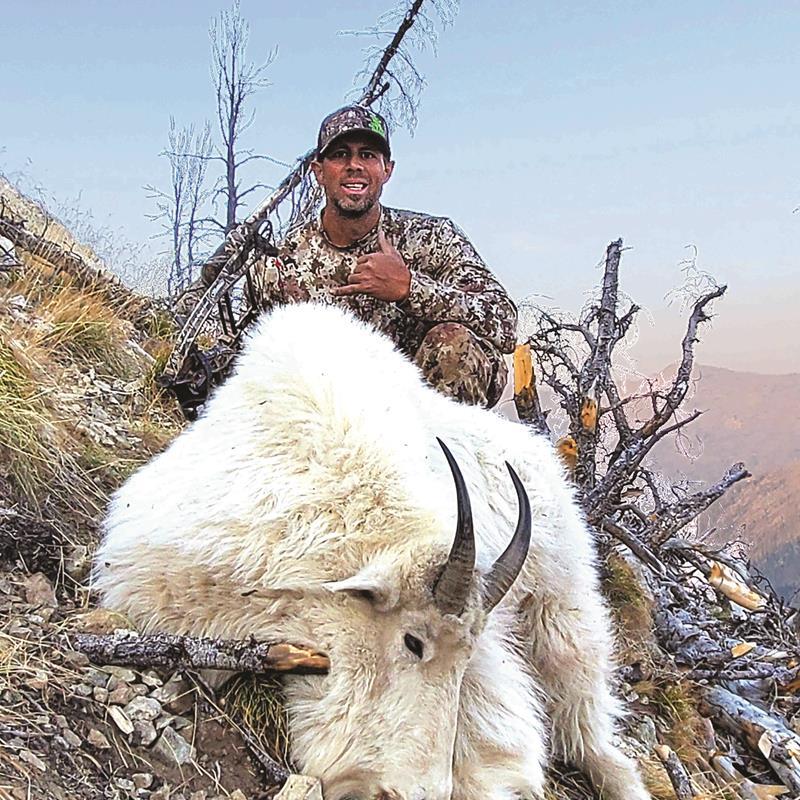
After drawing a once-in-a-lifetime California bighorn sheep tag last year in Idaho, I was restricted from applying for a
Rocky Mountain sheep tag for two years. I had a few options: either apply for a non-OIL tag or apply for mountain goat. Even with the low odds, I decided to throw in a goat application with very little hope that I would actually draw. When the results came out, you can imagine my disbelief when I received the email that read “Successful” for mountain goat.Having only been on one other mountain goat hunt—a friend’s tag—you could say I was going in fairly green. The next four months were a blur as I learned as much as I could about mountain goats and the hunting unit. It was time to put boots on the ground, learn access points and camping spots, and hopefully spot my adversary. Four scouting trips later, I felt like I had a pretty good idea of what I was in for. I set a goal of taking this animal with archery equipment, preferably a billy with long hair and high hopes it would qualify for Pope and Young. For my area, this was a lofty goal since there hadn’t been a goat with a horn length of at least 9" taken in the last 12 years—and that was with rifle odds.My first actual hunting trip was in late September. This was more of a scouting trip than a hunt. I was concerned about short goat hair and poor visibility from Idaho’s record-setting wildfires. Hiking and glassing were miserable. In those three days, I saw one goat—but fortunately, it was an old billy. It was my first stalk on a goat, and there I was staring at an absolute beast at 35 yards. I could count nine annuli and he seemed to have good hair. I was torn. Do I shoot this stud and accomplish my goal or wait? I passed and pulled out my camera. I snapped amazing pics as he stood in the smoke-covered landscape. Even my friends thought I was crazy for letting him walk.My first extended October trip yielded a handful of goats but no mature billies. I spent three full days hunting one large billy I had located during scouting. He either moved on, or he was zigging while I was zagging. The next few days were filled with adventure—finding a 100+ year-old miner’s pickaxe, calling wolves to 40 yards (no shot), and soaking in stunning scenery. The miles were adding up, and I was starting to regret my earlier decision.Three days at home with family was a much-needed reset. When I returned, I headed back to the spot where I’d passed on that original big billy. On my first evening, I spotted four mature billies. I now had at least three shooters and time to watch, learn, and wait.On day two, things looked promising. The biggest one, “Gorilla,” was working his way to the top of a distant ridge. I had a mile to loop around and meet him. But once there, what looked passable on a map turned unpassable in reality. I spotted Gorilla’s buddy bedded 60 yards away, but Gorilla vanished. I never saw him again.With two hours of light left, I dropped down the ridge toward the other two shooters. They were only 200 yards from where I had seen them that morning. With the steep terrain, I didn’t spot them until I was already in range. The first was a solid 8" billy. I wanted to see the other, whom I had previously guessed over 9". I couldn’t move without spooking the first, so I waited. Finally, the second billy stepped out and confirmed everything I hoped. He turned broadside, and my arrow found its mark. I watched him walk a short distance and expire. I had done it—archery, Pope and Young potential, and a beautiful billy with long hair.With a quick inReach message, my friends Oscar Williamson and Neil Adams were there the next day. Camp, meat, and billy on our backs, the eight-mile pack out was a breeze. I had spent 21 days in that unforgiving country, and it’s a hunt I will never forget.
Idaho Mountain Goat
Idaho Mountain Goat