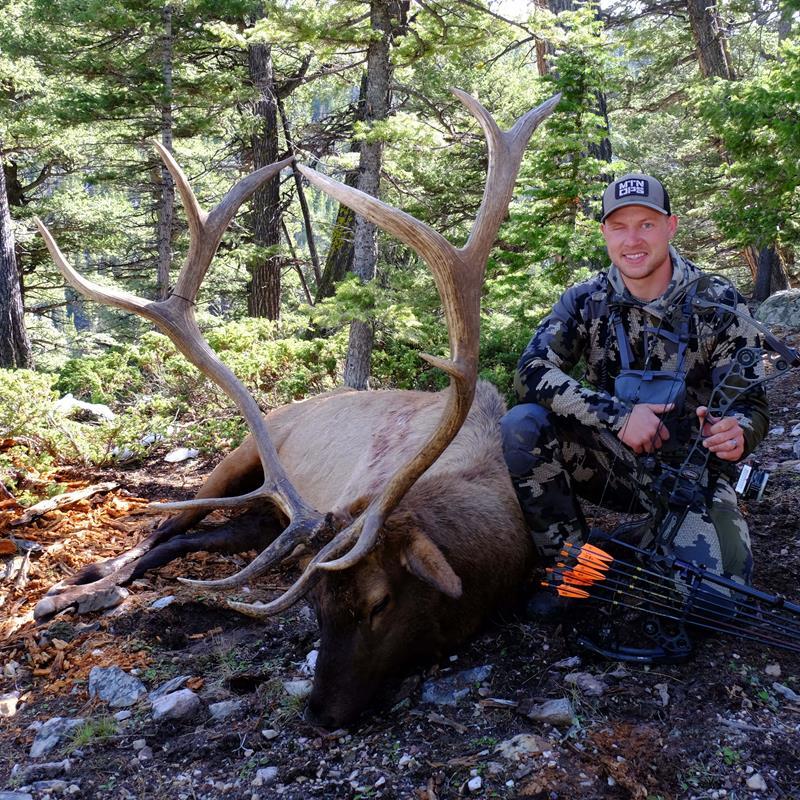
HF STAFF REMARKS - As the youngest Hunt Advisors on our team, Stanton and Isaiah represent a new generation of Huntin’ Fools. They inherited the hunting bug in an era where coveted draw tags can be expensive to pursue and rare to obtain. In light of that, we asked them to tag team an article that outlined a “dream tag” strategy while making sure that plenty of tags were notched along the way. — Jerrod Lile, Huntin’ Fool CEO
ISAIAH JONER
Growing up in Montana gave me enough opportunities each year that I never thought of looking at out-ofstate hunts. I really didn’t know where to begin, and I figured it was just too hard or too expensive to pick up tags in other states. Eventually, I got to the stage where I wanted to hunt more and have a chance at hunting limitedentry areas. After very little research, I figured out that there were more options in other states than I could handle each year. I decided to put a strategy together that would allow me to hunt over-the-counter hunts every year in multiple states while building points in other states for better units that would take less than 10 years to draw.
From a non-resident perspective, there are only a handful of states that offer true over-the-counter tags for deer and elk and most states require an application for antelope. I leave the states with true over-thecounter tags as a backup in case I am lucky enough to pull an awesome tag in the random draw game. Some states require up-front tag fees, some require you to buy a non-resident license before applying, and some just require an application fee up front. It’s hard to throw money at multiple state draws on a limited budget, but it can be worth it.
ARIZONA
Arizona requires you to purchase the $160 non-resident hunting licenses to apply for special draw permits. Once you purchase the license, the application for each species costs $15, so it is worth it to me to apply for all species. I know my chances at drawing the best tags are very slim, but they do allocate random tags. If you are not after the top units in the state for deer and elk, you have a good chance at drawing a permit within 10 years of applying. On top of that, Arizona offers some late s e a s o n archery over-the-counter tags for deer and elk that are worth a look when you are waiting to draw a better permit and already have a license
COLORADO
With the new point and fee structure in place, it’s really a no-brainer to apply for points in Colorado. The reason I do points here is because it is a true preference point state and they allocate tags to whoever applies with the most points. Therefore, you are able to look at previous data and determine when you can draw out in a unit. Colorado has a pile of great options for both the archery and rifle hunter. They also have true over-the-counter elk tags available, so at the end of the day, you can pick up a tag and go hunting.
IDAHO
Idaho is a great state to keep on your radar. You have to purchase the $164.75 hunting license to apply for any species in the state. Idaho’s draw process is purely random, so you could get lucky and pick up a tag your first year. The deadline to apply for deer, elk, and antelope isn’t until June, so you should know if you have drawn any other tags and decide if you should apply. You can also pick up true over-the-counter tags for deer and elk in Idaho. Several of the units that offer general archery tags are a draw for rifle, so in reality, you are hunting units that are being managed for quality animals. Even several of the better deer units have a general hunt during October but a limited-entry hunt in November. You are in an area where there is good trophy potential, but the dates you get with the general tag make it a bit harder to turn up a big deer. Idaho is my backup state if nothing else falls into place.
MONTANA
Montana used to be my home state, so I will probably hunt it every year. There are no over-the-counter tags available in Montana for non-residents. General tags for deer and elk must be applied for by March 15th and for antelope by June 1st. If you happen to miss the elk drawing deadline, all leftover tags become available first-come, first-served after the draw. The past couple of years, they have sold out extremely fast. Montana offers a six-week archery season and a five-week rifle season, so it gives hunters plenty of time to harvest. If you are unsuccessful during the archery hunt, your tag can still be used during rifle season in any open general area. There are only a couple of special draw deer units that are even worth applying for in Montana, but your chances of drawing are pretty slim. If you are an archery hunter, Montana has several good special draw areas for elk that are worth taking a look at that only require 1-5 points. Most special draw rifle elk hunts are tough to draw. For antelope, if you are an archery hunter, you can draw a tag almost every year and there are a lot of units you can pick up a rifle tag in that only take a couple points.
NEW MEXICO
New Mexico is a state I apply for every year. There are no points that go into play, so everything is a total random draw with them issuing 6% of tags to the non-resident pool. They do require you to front the full cost of the tag, but they have a fast turn around and will issue a full refund minus $13 for an application fee. I typically only apply for elk due to the out-of-pocket cost you have hanging out there for the four to five weeks it takes before they draw. There are other states I would rather pursue deer and antelope in. If you can afford it, there are other species in New Mexico you might consider applying for.
NEVADA
Nevada is another state that requires you to purchase a $156 hunting license if you plan on applying to build points or hunt. Once you purchase the license, it’s only $14 per species to apply, except for elk, which is $19. Nevada is more of a long-term state for me as it is extremely hard to draw any of the better tags. If you are an archery hunter, they have several decent mule deer units you can draw with only a couple points. Nevada has a random draw process, but they square your points. They also give you five choices on your application, which they look over before moving to the next applicant.
SOUTH DAKOTA
South Dakota is more of an opportunity state for me. Archery tags for mule deer, whitetail, and antelope are over-the-counter for the whole state. There are draws in place for rifle mule deer and whitetail that take a few years of applying to be in the running for a good unit. There is a lot of private land and finding big sections of public land to hunt can be a little difficult, so planning ahead and looking at unit maps before you pick up a tag will be beneficial. South Dakota is a good backup state for archery hunters who just want to get out west and hunt.
UTAH
Utah is now my home state, so I have started applying and building points for all that I can. From a non-resident prospective, Utah is an extremely hard state to get a good tag in. They allocate a portion of tags to the random draw, but your odds are very low. You have to purchase a $65 hunting license just to apply and then pay $10 for each species. They offer several good general deer and elk units across the state. The general elk tags are true over-the-counter tags, but the deer tags are by application only and can take a few points to draw, depending on your weapon preference. Utah is a state that I look at as a long-term investment with short-term deer tag opportunities.
WYOMING
Wyoming is another state that has a wide range of opportunities. If you are after any of the top units for deer, elk, or antelope, you will probably be applying and building points for several decades. However, if you are an opportunist, you should be able to hunt Wyoming every year for deer and antelope and every couple years for elk. Currently, I have just been purchasing and building points in Wyoming due to all the other states I hunt each year. It’s one of the states I am waiting until I have enough points to draw some of the better units in. Once I burn my points, I will go back after easy-to-draw units. Even though you may be at the bottom of the pile in states with points, you should still have some type of strategy in mind. Like I mentioned, a lot of these states are a random draw, so it’s worth it to have your name in the hat. You will donate a lot of money each year to these states, but one day, it might be worth it. At the end of the day, you have to pay to play, and I know that one day the thousands of dollars I spend over the years will eventually reward me with experiences that I can’t put a dollar amount on.
States & Species Isaiah Applies For State Species Over-the-Counter Tags Points Random Arizona All Species Yes Yes Yes Colorado Elk, Deer, & Antelope Yes Yes No Idaho Elk, Deer, & Antelope Yes No Yes Montana All Species No Yes Yes New Mexico Elk No No Yes Nevada All Species No Yes Yes South Dakota Deer & Antelope Yes Yes No Wyoming Elk & Antelope No Yes Yes STANTON UPSON Another good bison state is Wyoming States & Species Stanton Applies For State Species Points Random Arizona Sheep Yes Yes Colorado Sheep, Moose, & Goat Yes Yes Maine Moose Yes Yes Montana Sheep Yes Yes Nevada Sheep & Goat Yes Yes New Hampshire Moose Yes Yes South Dakota Bison Yes Yes Texas Sheep Yes Yes Utah Goat Yes Yes
ISAIAH JONER
Growing up in Montana gave me enough opportunities each year that I never thought of looking at out-ofstate hunts. I really didn’t know where to begin, and I figured it was just too hard or too expensive to pick up tags in other states. Eventually, I got to the stage where I wanted to hunt more and have a chance at hunting limitedentry areas. After very little research, I figured out that there were more options in other states than I could handle each year. I decided to put a strategy together that would allow me to hunt over-the-counter hunts every year in multiple states while building points in other states for better units that would take less than 10 years to draw.
From a non-resident perspective, there are only a handful of states that offer true over-the-counter tags for deer and elk and most states require an application for antelope. I leave the states with true over-thecounter tags as a backup in case I am lucky enough to pull an awesome tag in the random draw game. Some states require up-front tag fees, some require you to buy a non-resident license before applying, and some just require an application fee up front. It’s hard to throw money at multiple state draws on a limited budget, but it can be worth it.
ARIZONA
Arizona requires you to purchase the $160 non-resident hunting licenses to apply for special draw permits. Once you purchase the license, the application for each species costs $15, so it is worth it to me to apply for all species. I know my chances at drawing the best tags are very slim, but they do allocate random tags. If you are not after the top units in the state for deer and elk, you have a good chance at drawing a permit within 10 years of applying. On top of that, Arizona offers some late s e a s o n archery over-the-counter tags for deer and elk that are worth a look when you are waiting to draw a better permit and already have a license
COLORADO
With the new point and fee structure in place, it’s really a no-brainer to apply for points in Colorado. The reason I do points here is because it is a true preference point state and they allocate tags to whoever applies with the most points. Therefore, you are able to look at previous data and determine when you can draw out in a unit. Colorado has a pile of great options for both the archery and rifle hunter. They also have true over-the-counter elk tags available, so at the end of the day, you can pick up a tag and go hunting.
IDAHO
Idaho is a great state to keep on your radar. You have to purchase the $164.75 hunting license to apply for any species in the state. Idaho’s draw process is purely random, so you could get lucky and pick up a tag your first year. The deadline to apply for deer, elk, and antelope isn’t until June, so you should know if you have drawn any other tags and decide if you should apply. You can also pick up true over-the-counter tags for deer and elk in Idaho. Several of the units that offer general archery tags are a draw for rifle, so in reality, you are hunting units that are being managed for quality animals. Even several of the better deer units have a general hunt during October but a limited-entry hunt in November. You are in an area where there is good trophy potential, but the dates you get with the general tag make it a bit harder to turn up a big deer. Idaho is my backup state if nothing else falls into place.
MONTANA
Montana used to be my home state, so I will probably hunt it every year. There are no over-the-counter tags available in Montana for non-residents. General tags for deer and elk must be applied for by March 15th and for antelope by June 1st. If you happen to miss the elk drawing deadline, all leftover tags become available first-come, first-served after the draw. The past couple of years, they have sold out extremely fast. Montana offers a six-week archery season and a five-week rifle season, so it gives hunters plenty of time to harvest. If you are unsuccessful during the archery hunt, your tag can still be used during rifle season in any open general area. There are only a couple of special draw deer units that are even worth applying for in Montana, but your chances of drawing are pretty slim. If you are an archery hunter, Montana has several good special draw areas for elk that are worth taking a look at that only require 1-5 points. Most special draw rifle elk hunts are tough to draw. For antelope, if you are an archery hunter, you can draw a tag almost every year and there are a lot of units you can pick up a rifle tag in that only take a couple points.
NEW MEXICO
New Mexico is a state I apply for every year. There are no points that go into play, so everything is a total random draw with them issuing 6% of tags to the non-resident pool. They do require you to front the full cost of the tag, but they have a fast turn around and will issue a full refund minus $13 for an application fee. I typically only apply for elk due to the out-of-pocket cost you have hanging out there for the four to five weeks it takes before they draw. There are other states I would rather pursue deer and antelope in. If you can afford it, there are other species in New Mexico you might consider applying for.
NEVADA
Nevada is another state that requires you to purchase a $156 hunting license if you plan on applying to build points or hunt. Once you purchase the license, it’s only $14 per species to apply, except for elk, which is $19. Nevada is more of a long-term state for me as it is extremely hard to draw any of the better tags. If you are an archery hunter, they have several decent mule deer units you can draw with only a couple points. Nevada has a random draw process, but they square your points. They also give you five choices on your application, which they look over before moving to the next applicant.
SOUTH DAKOTA
South Dakota is more of an opportunity state for me. Archery tags for mule deer, whitetail, and antelope are over-the-counter for the whole state. There are draws in place for rifle mule deer and whitetail that take a few years of applying to be in the running for a good unit. There is a lot of private land and finding big sections of public land to hunt can be a little difficult, so planning ahead and looking at unit maps before you pick up a tag will be beneficial. South Dakota is a good backup state for archery hunters who just want to get out west and hunt.
UTAH
Utah is now my home state, so I have started applying and building points for all that I can. From a non-resident prospective, Utah is an extremely hard state to get a good tag in. They allocate a portion of tags to the random draw, but your odds are very low. You have to purchase a $65 hunting license just to apply and then pay $10 for each species. They offer several good general deer and elk units across the state. The general elk tags are true over-the-counter tags, but the deer tags are by application only and can take a few points to draw, depending on your weapon preference. Utah is a state that I look at as a long-term investment with short-term deer tag opportunities.
WYOMING
Wyoming is another state that has a wide range of opportunities. If you are after any of the top units for deer, elk, or antelope, you will probably be applying and building points for several decades. However, if you are an opportunist, you should be able to hunt Wyoming every year for deer and antelope and every couple years for elk. Currently, I have just been purchasing and building points in Wyoming due to all the other states I hunt each year. It’s one of the states I am waiting until I have enough points to draw some of the better units in. Once I burn my points, I will go back after easy-to-draw units. Even though you may be at the bottom of the pile in states with points, you should still have some type of strategy in mind. Like I mentioned, a lot of these states are a random draw, so it’s worth it to have your name in the hat. You will donate a lot of money each year to these states, but one day, it might be worth it. At the end of the day, you have to pay to play, and I know that one day the thousands of dollars I spend over the years will eventually reward me with experiences that I can’t put a dollar amount on.
States & Species Isaiah Applies For State Species Over-the-Counter Tags Points Random Arizona All Species Yes Yes Yes Colorado Elk, Deer, & Antelope Yes Yes No Idaho Elk, Deer, & Antelope Yes No Yes Montana All Species No Yes Yes New Mexico Elk No No Yes Nevada All Species No Yes Yes South Dakota Deer & Antelope Yes Yes No Wyoming Elk & Antelope No Yes Yes STANTON UPSON Another good bison state is Wyoming States & Species Stanton Applies For State Species Points Random Arizona Sheep Yes Yes Colorado Sheep, Moose, & Goat Yes Yes Maine Moose Yes Yes Montana Sheep Yes Yes Nevada Sheep & Goat Yes Yes New Hampshire Moose Yes Yes South Dakota Bison Yes Yes Texas Sheep Yes Yes Utah Goat Yes Yes