This adventure took seed at the Dallas SCI show in 2016 when we visited with Jim Lancaster of Northwest Territories Outfitters. He offered us a two-on-one option for moose and Dall sheep whereby Pam would have the opportunity to hunt moose and I would be on deck to hunt Dall sheep. The thing that sets the Lancaster operation above others is that transport into remote hunting areas is accomplished via helicopter. This was huge for us as we are both in our late sixties.
On September 1st, we departed Edmonton with a stopover in Yellow Knife and were greeted in Norman Wells with low ceilings and scattered flurries. The shuttle driver picking us up at the airport advised us that North Wright Air, our floatplane shuttle, would not be flying with the existing conditions, so they dropped us off at the hotel and advised us to remain in the lobby, ready to fly on a moment’s notice should the weather break to allow visual flight service. At around 5 p.m., the shuttle service with the air taxi service pulled up and announced that the weather was forecast to break and we would be flying out.
After a 45-minute flight, the floatplane settled onto the crystal waters of Lake June NWT and idled to the dock of NWTO where we were greeted by a host of guides and staff of Lancaster Family Outfitters. After a hearty meal of moose steak and all the trimmings, we were hurried out of the dining hall to shoot our rifles while there was still light.
Pam and I would be the first to leave for spike camp, which we learned was already set up. The chopper flight out was thrilling and gave us a great introduction to the rugged Mackenzie Mountains that would be home for the next several days. Master Don Burt and Guide Assistant Dennis Kitto had spent time glassing from a high vantage point and had already located a fine bull. Daylight was fading, and the sleeping bag felt good after a long day of traveling. We had no problems going right to sleep.
It must have been close to 8:00 when we crawled out of the sack to be greeted by Don who motioned for us to be very quiet as we had coffee and a granola bar. It seemed that the moose had moved much nearer to our location than where they had first spotted him. He was bedded just over the hill from camp.
We made our way off the ridge into a small valley and then climbed the next ridge, following it down and just below the crest to remain out of sight. We got to a point where we could ease over the top and be in shooting position of the bull. Pam was on the shooting sticks, waiting for the bull to stand and present a shot. After what seemed like a couple hours, Don gave a cow call to which the bull immediately responded by standing and looking our way. After 10 to 15 minutes, he finally moved about 30 yards closer. After no further response from the bull, Don moved around the hill about 30 yards and directed his calling away from the bull. The ploy was successful in making the bull think that the cow was moving away. To add a little extra enticement, Don bull grunted softly. That did the trick, and the bull closed to 200 yards and started moving parallel to us, coming into more open cover of willows instead of a spruce fir thicket. As the bull entered a small opening in the willows, Don threw him a cow call, giving Pam the opportunity to make the shot. Upon hearing the bullet thump, the bull wheeled and walked about 15 yards. The shot had pinwheeled the heart. The 200 grain ELDX out of the .300 Win Mag performed flawlessly, and the beast sank to the ground.
It took Don and Dennis four hours to quarter and bag the meat. They estimated that the live weight of Pam’s moose was over 2,000 pounds. It was 63 5/8" wide and scored 226". Pam returned to the main camp since her tags were filled, and Don, Dennis, and I were relocated to another area where the sheep adventure would begin at daylight. It was raining and spitting snow as we set up camp in the dark, and it was close to midnight by the time we crawled our tired bodies into the sleeping bags.
September 2nd greeted us with rain, and we stayed with the tents until close to 11 a.m. The weather appeared to be breaking, so by midday we started our ascent up the mountain to search for a band of six rams that had previously been located in the head of a small valley. As we crested the rim of the valley, Dennis and I hung back to allow Don to advance to see if the rams were still hanging in the area. After several minutes of glassing, Don set up the spotter and motioned for me to crawl up beside him. As I peered through the glass, my pulse quickened as I looked at six gorgeous rams bedded on the adjacent hillside. One was an ancient fellow that was pretty badly broomed with another one just a bit smaller with nice flairs. The only problem was that the shot was a bit too far for comfort and there was sparse cover should we break over the rim. While we waited, discussing options, I caught a glimpse of the sheep as they single filed over the top and out of our lives.
On September 3rd, we awoke to bright skies and cold temps. We hurriedly gulped down instant oatmeal and one more cup of coffee before making our ascent to see if we could relocate the rams we had blown out yesterday. We climbed over the mountain in the direction the sheep had gone and spent the day glassing but to no avail. At about 4 in the afternoon, Don used his Garmin InReach to let the main camp know our status. It was decided that we would be relocated again. Jim Lancaster flew in with the chopper pilot and advised us that three rams had been located in a high hanging valley and that it should not be a killer climb to get to them.
We awoke to a drizzle and flurries, gulped down coffee and granola bars for breakfast, and then started over the “small rise” that Jim said we would have to scale to peak over into the valley. After an hour and 10 minute vertical climb, we looked over into the valley. The rams were nowhere to be seen. We sat out near whiteout conditions for most of the day, but the rams didn’t show.
We awoke to a very cold, clear morning. We had coffee, oatmeal, and a long hike. Making it to the top, we checked the hanging valley again and our sheep were still not there. We climbed over the next peak to see if they possibly went over. Once over the top where we could glass the other side, it was obvious that the sheep had business elsewhere and were nowhere to be found.
The chopper came in, looked around, and there were no sheep, so they picked us up and we relocated camp once again. Camp was on a high, barren tundra with no apparent water. Once camp was established, Don took off walking, looking for a sheep and/or anywhere he might get water. I could see four ewes bedded on the next mountain, and we saw some rams feeding some distance below us as we flew in. At least I knew there were sheep in the area.
Don had found a pool of snowmelt for us to have water, so on September 6th, we arose to oatmeal and Don’s exceptional coffee. We made our way to where we could glass the area where the rams were bedded the afternoon before. They had moved and weren’t where we had seen them last. Don finally located them out the end of the hogback ridge nearer to camp.
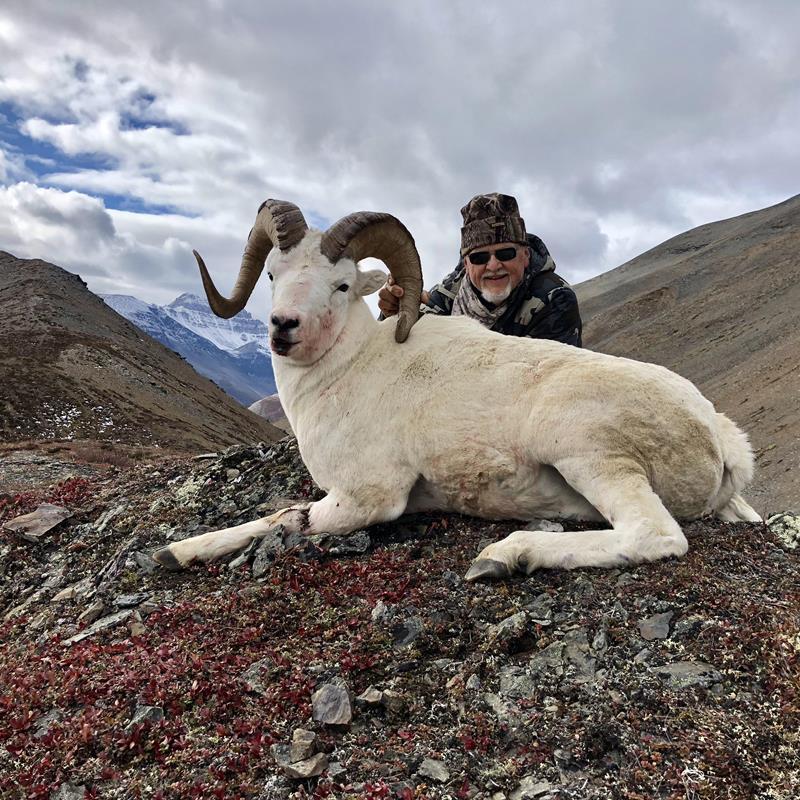
After about an hour-long stalk, we ended up on a vantage point 363 yards above the rams. Don set up the spotting scope and was able to pick out the largest of the six rams. They were bedded, so we had plenty of time to get set up on the backpack in prone position and wait. I lay in position approximately 45 minutes, and when they finally stood, my ram was standing slightly quartering to me. My first shot was a bit low, but the follow-up shot anchored my beautiful ram. Although he was only nine years old, his bases were 13 ½" and his unbroomed side measured 36". It was an epic end to a wonderful adventure to the Mackenzie Mountains of the Northwest Territories.
On September 1st, we departed Edmonton with a stopover in Yellow Knife and were greeted in Norman Wells with low ceilings and scattered flurries. The shuttle driver picking us up at the airport advised us that North Wright Air, our floatplane shuttle, would not be flying with the existing conditions, so they dropped us off at the hotel and advised us to remain in the lobby, ready to fly on a moment’s notice should the weather break to allow visual flight service. At around 5 p.m., the shuttle service with the air taxi service pulled up and announced that the weather was forecast to break and we would be flying out.
After a 45-minute flight, the floatplane settled onto the crystal waters of Lake June NWT and idled to the dock of NWTO where we were greeted by a host of guides and staff of Lancaster Family Outfitters. After a hearty meal of moose steak and all the trimmings, we were hurried out of the dining hall to shoot our rifles while there was still light.
Pam and I would be the first to leave for spike camp, which we learned was already set up. The chopper flight out was thrilling and gave us a great introduction to the rugged Mackenzie Mountains that would be home for the next several days. Master Don Burt and Guide Assistant Dennis Kitto had spent time glassing from a high vantage point and had already located a fine bull. Daylight was fading, and the sleeping bag felt good after a long day of traveling. We had no problems going right to sleep.
It must have been close to 8:00 when we crawled out of the sack to be greeted by Don who motioned for us to be very quiet as we had coffee and a granola bar. It seemed that the moose had moved much nearer to our location than where they had first spotted him. He was bedded just over the hill from camp.
We made our way off the ridge into a small valley and then climbed the next ridge, following it down and just below the crest to remain out of sight. We got to a point where we could ease over the top and be in shooting position of the bull. Pam was on the shooting sticks, waiting for the bull to stand and present a shot. After what seemed like a couple hours, Don gave a cow call to which the bull immediately responded by standing and looking our way. After 10 to 15 minutes, he finally moved about 30 yards closer. After no further response from the bull, Don moved around the hill about 30 yards and directed his calling away from the bull. The ploy was successful in making the bull think that the cow was moving away. To add a little extra enticement, Don bull grunted softly. That did the trick, and the bull closed to 200 yards and started moving parallel to us, coming into more open cover of willows instead of a spruce fir thicket. As the bull entered a small opening in the willows, Don threw him a cow call, giving Pam the opportunity to make the shot. Upon hearing the bullet thump, the bull wheeled and walked about 15 yards. The shot had pinwheeled the heart. The 200 grain ELDX out of the .300 Win Mag performed flawlessly, and the beast sank to the ground.
It took Don and Dennis four hours to quarter and bag the meat. They estimated that the live weight of Pam’s moose was over 2,000 pounds. It was 63 5/8" wide and scored 226". Pam returned to the main camp since her tags were filled, and Don, Dennis, and I were relocated to another area where the sheep adventure would begin at daylight. It was raining and spitting snow as we set up camp in the dark, and it was close to midnight by the time we crawled our tired bodies into the sleeping bags.
September 2nd greeted us with rain, and we stayed with the tents until close to 11 a.m. The weather appeared to be breaking, so by midday we started our ascent up the mountain to search for a band of six rams that had previously been located in the head of a small valley. As we crested the rim of the valley, Dennis and I hung back to allow Don to advance to see if the rams were still hanging in the area. After several minutes of glassing, Don set up the spotter and motioned for me to crawl up beside him. As I peered through the glass, my pulse quickened as I looked at six gorgeous rams bedded on the adjacent hillside. One was an ancient fellow that was pretty badly broomed with another one just a bit smaller with nice flairs. The only problem was that the shot was a bit too far for comfort and there was sparse cover should we break over the rim. While we waited, discussing options, I caught a glimpse of the sheep as they single filed over the top and out of our lives.
On September 3rd, we awoke to bright skies and cold temps. We hurriedly gulped down instant oatmeal and one more cup of coffee before making our ascent to see if we could relocate the rams we had blown out yesterday. We climbed over the mountain in the direction the sheep had gone and spent the day glassing but to no avail. At about 4 in the afternoon, Don used his Garmin InReach to let the main camp know our status. It was decided that we would be relocated again. Jim Lancaster flew in with the chopper pilot and advised us that three rams had been located in a high hanging valley and that it should not be a killer climb to get to them.
We awoke to a drizzle and flurries, gulped down coffee and granola bars for breakfast, and then started over the “small rise” that Jim said we would have to scale to peak over into the valley. After an hour and 10 minute vertical climb, we looked over into the valley. The rams were nowhere to be seen. We sat out near whiteout conditions for most of the day, but the rams didn’t show.
We awoke to a very cold, clear morning. We had coffee, oatmeal, and a long hike. Making it to the top, we checked the hanging valley again and our sheep were still not there. We climbed over the next peak to see if they possibly went over. Once over the top where we could glass the other side, it was obvious that the sheep had business elsewhere and were nowhere to be found.
The chopper came in, looked around, and there were no sheep, so they picked us up and we relocated camp once again. Camp was on a high, barren tundra with no apparent water. Once camp was established, Don took off walking, looking for a sheep and/or anywhere he might get water. I could see four ewes bedded on the next mountain, and we saw some rams feeding some distance below us as we flew in. At least I knew there were sheep in the area.
Don had found a pool of snowmelt for us to have water, so on September 6th, we arose to oatmeal and Don’s exceptional coffee. We made our way to where we could glass the area where the rams were bedded the afternoon before. They had moved and weren’t where we had seen them last. Don finally located them out the end of the hogback ridge nearer to camp.
After about an hour-long stalk, we ended up on a vantage point 363 yards above the rams. Don set up the spotting scope and was able to pick out the largest of the six rams. They were bedded, so we had plenty of time to get set up on the backpack in prone position and wait. I lay in position approximately 45 minutes, and when they finally stood, my ram was standing slightly quartering to me. My first shot was a bit low, but the follow-up shot anchored my beautiful ram. Although he was only nine years old, his bases were 13 ½" and his unbroomed side measured 36". It was an epic end to a wonderful adventure to the Mackenzie Mountains of the Northwest Territories.