November 2025
_CMYK.jpg?width=1600&height=900&name=image1%20(2)_CMYK.jpg)
Montana, Wyoming & Idaho Hunting
Another year has flown by, and elk season is right around the corner. This time of year, we are taking a lot of calls from our members to help in finalizing plans for their upcoming hunts. Some of these conversations are spent answering questions about hunting in grizzly bear country. Understandably, hunting these areas can come with some nerves of experiencing the worst-case scenario of a fatal attack. When these incidents do occur, it’s always national news and makes them feel more common than they really are. For most, it is a combination of that and the fear of not knowing what to expect when hunting in griz country that has a hunter on edge. However, a look at the historical data proves that fatal attacks in the lower 48 are incredibly rare when considering the amount of recreationalist who are hiking, camping, fishing, and hunting in grizzly country every year. High bear density areas of the greater Yellowstone and Glacier Park areas alone see over 7 million visitors between them each year.
A Look at the Numbers:
- Since the year 1900, there have been a total of 32 documented human fatalities by grizzly bear, all of them taking place in either Montana (21) or Wyoming (11).
- All of these attacks have occurred between the dates of March 25th and October 30th.
- The month of July accounts for the highest occurrence (8) of any month, unsurprisingly coinciding with the peak of the tourism season.
- Of the 32 attacks, most took place within the boundaries of Glacier or Yellowstone National Park, with only 14 of them happening outside of the park.
- All but 10 of the victims were alone at the time of the attack.
- 20 occurrences were by grizzlies encountered in the field, the other 12 taking place in a tent or at a campsite.

Graph: Deaths by Month
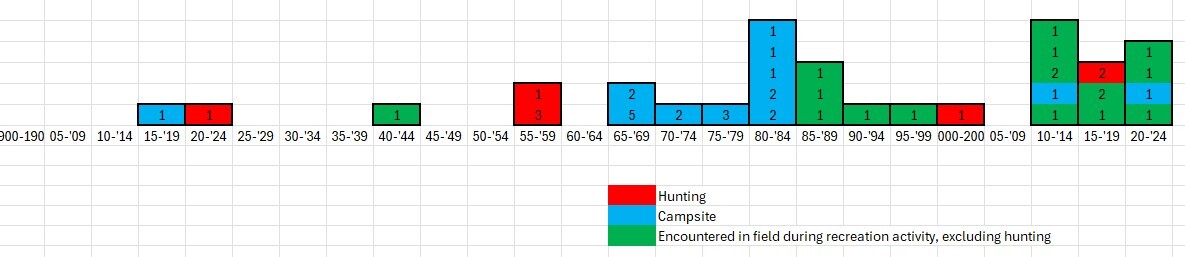
Graph: Deaths by Year
Hunting in Griz Country
I’ve been hunting in Montana’s grizzly country for over 30 years now and have yet to have a close call with a grizzly bear. Aside from terribly bad luck, staying safe in bear country simply comes down to being aware and having a little common sense. Personally, I don’t change much when hunting in griz country compared to when hunting outside of it. It really just comes down to three main things for me.
The first is to keep a clean camp. This means not throwing unfinished food in nearby brush and hanging my food in a bear bag. A 50-foot length of paracord and a drybag are all the extra gear required to hang and use a bear bag. The bear bag is hung from a suitable tree a few hundred yards downwind from camp. The tree will have a branch at least 15 feet off the ground. Tie a rock or stick to one end of the paracord and throw it over the branch while keeping the other end of the paracord. You want the cord to go over the branch five or six feet away from the trunk of the tree. Let the rock down to the ground and replace it with your dry bag. Finally, pull the bag off of the ground back up to the branch before tying the paracord off to whatever is around to keep the bear bag in place.
Another consideration is when dealing with meat. The time to be most aware is when you are at a carcass after a kill. Aside from Alaska, there have been five hunters killed in the states since 1900, only two of those happening since 1958. In each of the two most recent cases, the hunter was breaking down an elk carcass at the time of the attack. It is important to get whatever meat you aren’t packing out on the first trip, moved a few hundred yards away from the carcass, upwind ideally. In a perfect world, you are hanging it far off the ground like a bear bag, but you won’t know how difficult that is until you’ve tried that with an elk quarter. I usually just hang the meat a foot or two above the ground for air circulation and then cross my fingers. Before taking off, I will leave any extra clothing I have in the branches by the meat, the sweatier the better. I will also urinate on the ground a few feet away from the meat to leave as much human scent as possible. A bear can smell a carcass from miles away, so you always need to be extra cautious when returning to a kill site to retrieve meat left overnight. Make some noise and have your bear protection ready as you return to the cache. Approach the meat from the direction that allows the best visibility while still being fully aware of your 360 degrees.
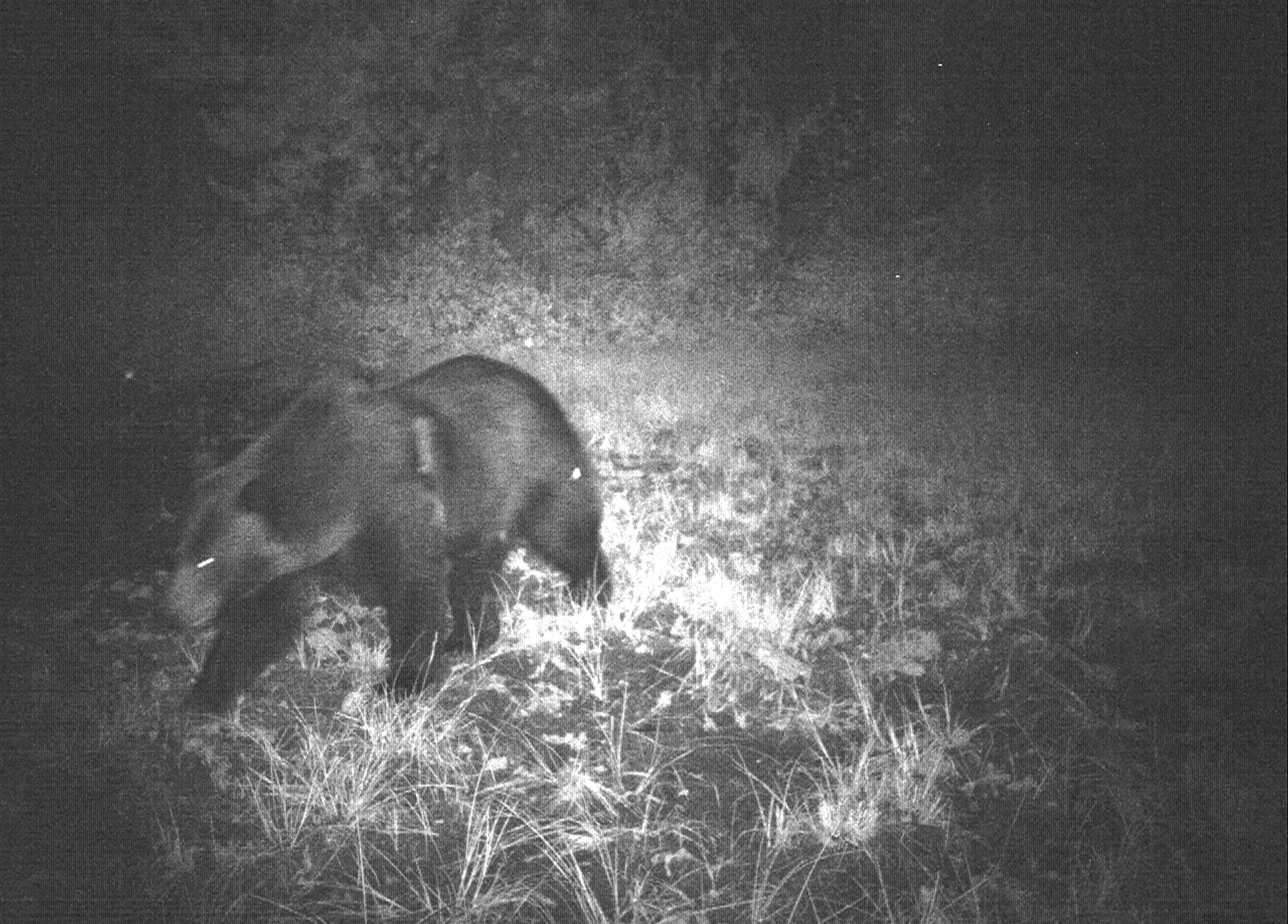
My third consideration is bear protection. I rarely carry bear spray or a sidearm when I’m archery hunting in fringe griz country. When hunting heavier density griz areas, I will carry either spray or a pistol, depending on the situation. Some prefer one over the other in all cases, which is fine, but each have their pros and cons. For me, it usually comes down to packing a sidearm when I am day hunting and spray when I am hunting out of a pack just to cut down on a few pounds of weight. That said, if you know you’ll be nervous in griz country, you might not get much sleep in a tent if all you’ve got is a can of bear spray lying next to you.
The decision to hunt or avoid hunting griz country really comes down to how well you can mentally manage it. The purpose of being on a hunt is defeated if you can’t have fun and be able to enjoy yourself out there. If you can focus on the statistical improbability of a bad grizzly encounter during the hunt instead of how terrifying it would be getting mauled, you’ll have a good hunt. Unfortunately for some, you won’t really know until you are out there. I’ve hunted with plenty of guys on their first hunts in bear country, and I’ve seen it go both ways. If you are on the fence, I would give it a shot. Much of the best elk opportunity in Montana and Wyoming coincides with bear country. It also happens to be some of prettiest country in each state, and you are robbing yourself of experiencing what it has to offer by falling to the fear of the worst case.
Looking Ahead: Management by Politics or Science?
In the lower 48, 12 people have been killed in the last 15 years with the other 20 spanning over the previous 110 years. There is no arguing that attacks are becoming more frequent as bear populations continue to increase, and as a result, their range expands by the year. This spring, a bear was killed in self-defense in the Bear’s Paw Mountains of Montana only a few miles from Eastern Montana’s Upper Missouri Breaks. Last spring, a bear was removed after attacking livestock along the southern end of Wyoming’s Bighorn Mountains. The year prior, a sighting in Montana’s Pryor Mountains was confirmed. Grizzly bears haven’t lived in any of these three areas for over a century. Their expansion into unsuitable habitat has led to increased conflict potential between bears and humans. Between them, Montana and Wyoming are having to kill nearly 100 grizzly a year, the vast majority in response to livestock depredation or by act of self-defense.
The solution, of course, is to begin managing these bears through science rather than politics. There is some hope on the horizon as House Resolution 281 is currently making its way through the congressional process. If passed, this act will remove the Greater Yellowstone bear population from the endangered and threatened wildlife list and transfer management from the feds back into the rightful hands of the state. The Yellowstone bear population has been protected under the Endangered Species Act for 50 years with an initial minimum population recovery goal of 500 bears. That goal was met 30 years ago and now sits well over 1,000 grizzly bears. We are way past due for the opening of a hunting season to help manage these bears. It is time to start sending a few bullets their way to let hunters manage numbers as well, putting a little fear back into them of encountering humans again. Until that happens, we can expect to see human, grizzly, and livestock depredation mortality numbers to continue their climb.