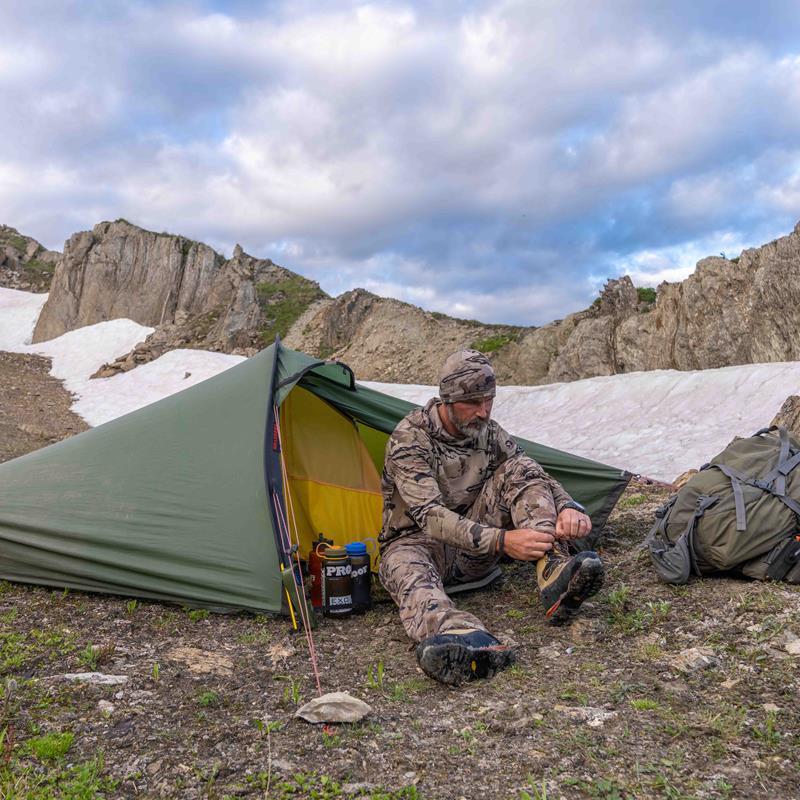
Former hunting guide Luke Carrick is a full-time hunt photographer who uses his camera to capture his clients’ hunts from start to finish. “What we do – there’s only one or two percent of us in the world that do this extreme, physical, very difficult stuff,” he says. As a result, he’s set on capturing more than just a trophy shot because the struggles faced during a big game hunt are what make it so memorable and make it a story worth telling. “I’ve been there. I’ve done it. I know the stress, I know the mental, physical parts of it, and I know the photos that I’d love to have,” he says.
Luke has traveled throughout the U.S., Canada, Mexico, and even as far away as Argentina and South Africa to document these journeys. “A lot of people vacation away on the beach; we go on vacation to throw a 70-pound pack on for 15 days and chase sheep,” he says. Every trip is a cherished opportunity, but no easy task. “If you train hard, physically, you’ll be ready, but that doesn’t mean mentally you’re going to be,” he emphasizes. But there is one way he always sets himself up for success: using gear he knows and trusts.
“I’ve tested everything for a long, long time,” he says, adding, “Now that I’ve tested it so much, I always stick with the same stuff over and over because I know it doesn’t fail.” Over his many years as an outdoorsman and guide, he’s seen his fair share of less than capable gear and had to deal with the consequences. “I started backpacking when I was 17 with metal frame packs, cans of chili – the hard way,” he says. As he got more experience, the trips got harder and the stakes became greater. “These conditions we’re in are totally extreme. Mother nature is brutal, and if you don’t have that stuff, sometimes it’s life or death,” he says. To keep going farther, he knew he needed to improve his system.
THE HILLEBERG AKTO
At the very worst, unreliable gear puts your life at risk. At a minimum, it can make your life miserable. When it comes to something as important as a once-in-a-lifetime hunt, you don’t want to spend it cold, wet, and full of regret. “Every stress you have puts that pressure on you,” Luke says. “Every time gear fails, a guy might go home.” As the first line of defense for when things get rough, he says, your tent is an especially crucial piece of gear to get right.
To keep himself safe throughout his trips, Luke has put his trust in his Hilleberg Akto for the last 20 years. “That Akto has been through a lot,” he puts it simply. “For me, it’s perfect. It’s small, it’s light – you don’t even know it’s on your back. Everything you’d want in a tent for sure.” Weighing just 3 lbs. 12 oz., the Akto is impressively light for a tent that can stand up to just about any weather the backcountry can throw your way. For hunters like Luke who truly need that kind of strength, it’s near-impossible to find an equally capable tent. Even after 20 years of hard use, he’s never needed to replace his tent. It’s stood up to every test thrown at it over the last two decades.
Luke has been in countless situations where, if his tent had failed, the outcome would have been catastrophic. During a four-week-long solo Stone sheep scouting trip in B.C., he and his Akto were bombarded for 12 hours with torrential downpours and winds up to 60 mph at 7,000 feet on the mountain, all with no issue. “I spent 28 days in that thing, living with the grizzlies up in the rocks and traveling all over. It’s just super reliable,” he says.
Similarly, during a late-season elk hunt in Arizona, Luke was again caught in heavy rain. He and his partner came back to camp to find both their Aktos covered with thick, muddy water from a nearby creek, but the tents were still standing just fine. “I could not believe they made it through,” he marvels. In that moment, they needed to decide whether they could continue the hunt. “I was like, ‘Dude, we can pack up and go out and dry everything out and start over,’ and he’s like, ‘No, we’re hunting, let’s stay here. Let’s clean up the stuff.’ And we just got the mud off, hung up everything, got it dry, and we killed his elk the next day,” he says.
CELEBRATING 30 YEARS OF THE HILLEBERG AKTO
The Akto’s unique construction is the result of thoughtful design and rigorous testing. Before it was introduced in 1995, Hilleberg founders Bo and Renate Hilleberg made 17 different prototypes before they were finally satisfied with the tent. Its innovative construction uses a single pole to keep its weight low, and its outer tent is made of Hilleberg’s very strong Kerlon 1200 fabric, a triple silicone-coated ripstop nylon. When the Akto was first introduced, there was nothing like it on the market. Today, 30 years later, its design has changed relatively little, and it remains one of Hilleberg’s best-selling models.
Luke’s 20-year-old Akto is just as functional today as it was when he first got it, even after everything it’s been through. “For me, it’s perfect. I love the headspace, I love that vestibule,” he says. It’s roomy and comfortable enough for his extended trips into the backcountry and compact enough to be easily pitched in the small spaces up on mountain ridges he often finds himself in. Luke has used other Hilleberg models as well, like the all-season Nallo 2, a two-person tent which he sizes up to for colder, late-season hunts to give himself extra room for a small cot. For trips in warmer climates like the desert, he sometimes uses the one-person Enan, which is very similar in design to the Akto, but rather than being built for all seasons, is meant for snow-free use only and offers added ventilation with its large all-mesh panels.
MAKING A MEMORABLE HUNT
No matter what kinds of hunts he goes on, Luke needs his equipment to perform. “If you have a tent like a Hilleberg, it will keep you out there longer,” he says. “You’re not going to have that problem where you’re stressing out because you’re cold or wet. It’s one less stress you have to worry about,” he says. On many trips, his tent has made the difference between success and failure, between making good memories or bad ones.
The photos he captures are a gift he gets to give to his clients, a way for them to hold onto the memories of their trips. “You create these lifelong hunting buddies forever,” Luke says. “I have some guys that will say ‘it’s not the trophies that matter to me, it’s your photo book,” he says, “I think that’s why I love it so much, because these guys appreciate it so much.” Ultimately, every hunt poses an opportunity, but so many things have to go right in order to make it a success. When you put in the work, make the right choices, and use quality gear, you set yourself up for the best chance at making your time in the backcountry truly memorable.
If you want to learn more about Hilleberg tents, visit hilleberg.com, and if you’d like to learn more about Luke Carrick’s hunt photography, visit guideriteadventures.com.
Luke has traveled throughout the U.S., Canada, Mexico, and even as far away as Argentina and South Africa to document these journeys. “A lot of people vacation away on the beach; we go on vacation to throw a 70-pound pack on for 15 days and chase sheep,” he says. Every trip is a cherished opportunity, but no easy task. “If you train hard, physically, you’ll be ready, but that doesn’t mean mentally you’re going to be,” he emphasizes. But there is one way he always sets himself up for success: using gear he knows and trusts.
“I’ve tested everything for a long, long time,” he says, adding, “Now that I’ve tested it so much, I always stick with the same stuff over and over because I know it doesn’t fail.” Over his many years as an outdoorsman and guide, he’s seen his fair share of less than capable gear and had to deal with the consequences. “I started backpacking when I was 17 with metal frame packs, cans of chili – the hard way,” he says. As he got more experience, the trips got harder and the stakes became greater. “These conditions we’re in are totally extreme. Mother nature is brutal, and if you don’t have that stuff, sometimes it’s life or death,” he says. To keep going farther, he knew he needed to improve his system.
THE HILLEBERG AKTO
At the very worst, unreliable gear puts your life at risk. At a minimum, it can make your life miserable. When it comes to something as important as a once-in-a-lifetime hunt, you don’t want to spend it cold, wet, and full of regret. “Every stress you have puts that pressure on you,” Luke says. “Every time gear fails, a guy might go home.” As the first line of defense for when things get rough, he says, your tent is an especially crucial piece of gear to get right.
To keep himself safe throughout his trips, Luke has put his trust in his Hilleberg Akto for the last 20 years. “That Akto has been through a lot,” he puts it simply. “For me, it’s perfect. It’s small, it’s light – you don’t even know it’s on your back. Everything you’d want in a tent for sure.” Weighing just 3 lbs. 12 oz., the Akto is impressively light for a tent that can stand up to just about any weather the backcountry can throw your way. For hunters like Luke who truly need that kind of strength, it’s near-impossible to find an equally capable tent. Even after 20 years of hard use, he’s never needed to replace his tent. It’s stood up to every test thrown at it over the last two decades.
Luke has been in countless situations where, if his tent had failed, the outcome would have been catastrophic. During a four-week-long solo Stone sheep scouting trip in B.C., he and his Akto were bombarded for 12 hours with torrential downpours and winds up to 60 mph at 7,000 feet on the mountain, all with no issue. “I spent 28 days in that thing, living with the grizzlies up in the rocks and traveling all over. It’s just super reliable,” he says.
Similarly, during a late-season elk hunt in Arizona, Luke was again caught in heavy rain. He and his partner came back to camp to find both their Aktos covered with thick, muddy water from a nearby creek, but the tents were still standing just fine. “I could not believe they made it through,” he marvels. In that moment, they needed to decide whether they could continue the hunt. “I was like, ‘Dude, we can pack up and go out and dry everything out and start over,’ and he’s like, ‘No, we’re hunting, let’s stay here. Let’s clean up the stuff.’ And we just got the mud off, hung up everything, got it dry, and we killed his elk the next day,” he says.
CELEBRATING 30 YEARS OF THE HILLEBERG AKTO
The Akto’s unique construction is the result of thoughtful design and rigorous testing. Before it was introduced in 1995, Hilleberg founders Bo and Renate Hilleberg made 17 different prototypes before they were finally satisfied with the tent. Its innovative construction uses a single pole to keep its weight low, and its outer tent is made of Hilleberg’s very strong Kerlon 1200 fabric, a triple silicone-coated ripstop nylon. When the Akto was first introduced, there was nothing like it on the market. Today, 30 years later, its design has changed relatively little, and it remains one of Hilleberg’s best-selling models.
Luke’s 20-year-old Akto is just as functional today as it was when he first got it, even after everything it’s been through. “For me, it’s perfect. I love the headspace, I love that vestibule,” he says. It’s roomy and comfortable enough for his extended trips into the backcountry and compact enough to be easily pitched in the small spaces up on mountain ridges he often finds himself in. Luke has used other Hilleberg models as well, like the all-season Nallo 2, a two-person tent which he sizes up to for colder, late-season hunts to give himself extra room for a small cot. For trips in warmer climates like the desert, he sometimes uses the one-person Enan, which is very similar in design to the Akto, but rather than being built for all seasons, is meant for snow-free use only and offers added ventilation with its large all-mesh panels.
MAKING A MEMORABLE HUNT
No matter what kinds of hunts he goes on, Luke needs his equipment to perform. “If you have a tent like a Hilleberg, it will keep you out there longer,” he says. “You’re not going to have that problem where you’re stressing out because you’re cold or wet. It’s one less stress you have to worry about,” he says. On many trips, his tent has made the difference between success and failure, between making good memories or bad ones.
The photos he captures are a gift he gets to give to his clients, a way for them to hold onto the memories of their trips. “You create these lifelong hunting buddies forever,” Luke says. “I have some guys that will say ‘it’s not the trophies that matter to me, it’s your photo book,” he says, “I think that’s why I love it so much, because these guys appreciate it so much.” Ultimately, every hunt poses an opportunity, but so many things have to go right in order to make it a success. When you put in the work, make the right choices, and use quality gear, you set yourself up for the best chance at making your time in the backcountry truly memorable.
If you want to learn more about Hilleberg tents, visit hilleberg.com, and if you’d like to learn more about Luke Carrick’s hunt photography, visit guideriteadventures.com.