Nobody ever said raising kids or elk hunting was easy. When you try to combine the two, it can be a challenge. However, like elk hunting and other outdoor adventures, sometimes the most rewarding experiences are those that involve a little discomfort, some sweat and determination, and a lot of lessons learned. The tough part for a parent is just finding the time and right opportunity.
For us, the right opportunity came along this year. My older son, Jackson, was fortunate enough to have successfully drawn a youth bull tag in the state of Utah, good for any general unit in mid to late September. I probably spent more time preparing for this hunt than any other elk hunt I have been a part of. I contacted a couple of guys who had successfully filled tags with their kids on this hunt and made some calls to several Utah Division of Wildlife Resources biologists. By the time we left for the trip, I had four spots picked out with contingencies for each.
I drove solo out to Utah a few days before the start of the season to locate a good base camp and do a little scouting for elk. In my preseason scouting, I had seen some evidence of rut activity by the elk (i.e., tree rubs, mud wallows, etc.) but had not heard a single bugle. In hopes of calling in a curious bull, we spent the first two days of the hunt doing a lot of glassing and some blind calling set ups at the edge of timber harvest units and burns.
I’m not sure what it is about day three of a hunt, but I have found that good things happen on day three, as was the case with our elk hunt this year in Utah. My buddy had given us some detailed information about a ridge and series of meadows located approximately four miles from our camp where his daughter had shot a bull several years earlier. Getting in there would require almost a two-mile hike behind a locked gate and then hiking off trail through a series of older harvest units and meadows.
At around 4:30 that afternoon, the elk sign and smell of elk was significant enough that we slowed our pace.
At some point, I whispered to Jackson, “This spot is starting to get real elkie.”
That was my way of saying there was a good chance we were going to run into or spot some elk still hunting through the timber. Maybe the elk would be coming through the saddle that evening and we would have an opportunity at a bull. We were now about two and a half miles from the truck, so that was also on my mind.
At about this time, I told Jackson to get right beside me so that as we moved through the timber I could glass and then communicate quietly with him on what I was seeing. No more than 10 minutes later, I caught motion to my left and saw the outline of an elk moving through the timber. I didn’t get a great look at the silhouette of the elk passing through some trees, but I did see some small antlers that resembled those of a spike bull.
I turned to Jackson and whispered, “Do you want to shoot a spike?”
He thought about it for a second and then said yes. He was ready to take this opportunity should it present itself. I was pretty sure the elk had only detected our movement and had not winded us, so I cow called a couple of times to potentially slow him down and pique his interest. We quickly checked wind direction and then moved in behind the location where the elk had just passed. We were also noting that the timbered area along this meadow quickly gave way to a steeper, more open hillslope. I hoped that as we worked along this edge, following the direction of the elk, that he might move upslope to seek higher ground and thereby allow Jackson an open shot. As soon as we got within 20 yards of the base of the hillslope, I spotted the tan body of an elk.
“There he is,” I whispered to Jackson. “Take two steps to your left to get a clear shot.”
As soon as Jackson stepped into his shooting lane, he raised the rifle, confirmed his target, and shot off-hand from approximately 70 yards. Within seconds after the loud report of the .300 Win Mag, we heard branches breaking, some rockfall, and what sounded like the clattering of antlers. We sat down on the ground and collected ourselves for a few minutes. Just like that, we realized the hunt was probably over. We had taken the first opportunity that presented itself, and it was likely that a spike bull lay dead within 100-150 yards of where we sat.
We gave it about 10 minutes and then decided to walk up to the spot where the elk had been standing when Jackson shot. When we got to the spot, there was no obvious sign of a blood trail. The hillslope was fairly open of brush and understory vegetation, so we started to slowly move in the direction that the elk had run. I told Jackson to get out in front and be ready to shoot again if he spotted the bull and it was still alive. Within 40 yards, he looked back at me and pointed to a spot just ahead.
“He’s right there, Dad. And Dad, he’s not a spike!”
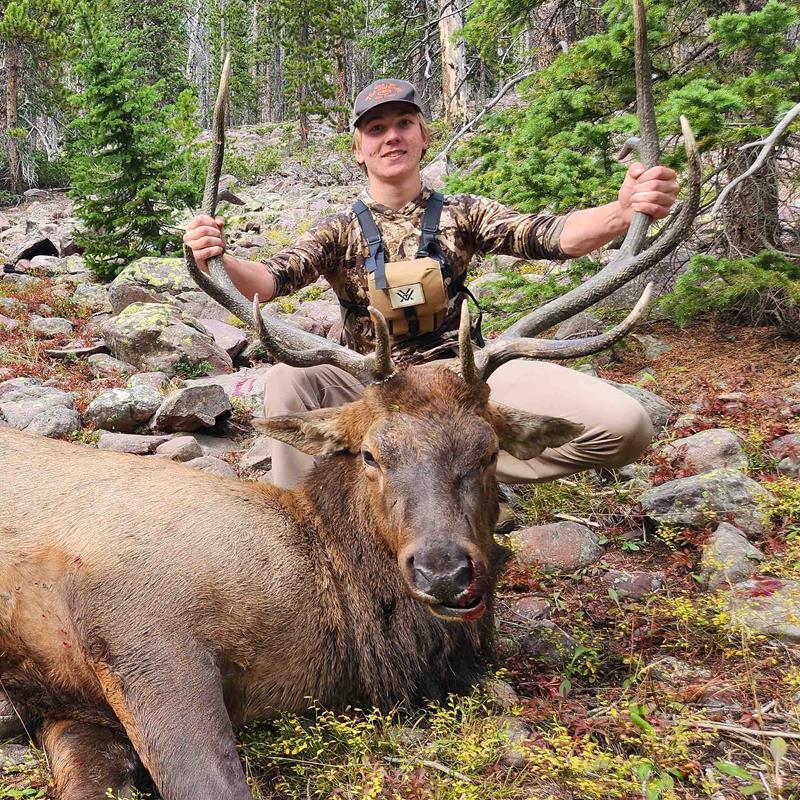
I joined his side, and there, another 30 yards ahead, was a mature 5x5 bull lying dead on the hillside. We closed the distance and took a few moments to give our thanks and gratitude to the bull for the life he had just given us and the meat that he would be providing us for the next year. This may not have been a trophy-sized, Boone and Crockett Rocky Mountain elk, but it was a mature, branch-antlered bull and a trophy for this 16-year-old youth hunter.
After about 10 minutes of pictures and reflection on what had just transpired, we got busy breaking down the elk. The hillside was rocky but not incredibly steep or covered with understory vegetation. It was a pretty great spot to show Jackson how to use the gutless method for quartering the elk. Once we had all of the meat in game bags, we found an old snag about 75 yards from the carcass with branches large enough and far enough off the ground to hang several of the game bags for the night.
By this time, it was a little after 9 p.m. The moonlit night suddenly became obscured by large clouds as a thunderstorm approached. As it started to rain, we loaded several bags of meat into our packs. This was a heavy load; each of our packs probably weighed close to 100 lbs. With the packs loaded and the remaining game bags secure and hanging for the next load, we carefully started making our way back to the pickup. When our heads finally hit the pillow at around 1 a.m., we were both exhausted but also feeling a little euphoric with the success of the evening hunt.
The following morning, we headed back out to get the second load at around 9 a.m. Despite some stiff legs, there was a spring in both of our steps as we covered the same route as the night before to retrieve the remaining bags. We were back at the truck by noon and began the process of breaking camp and preparing for the long drive back home.
It has become family tradition to process our own game. Although I took the lead with the bulk of the processing, Jackson did take an active role, and between the two of us, we had all the meat cut, wrapped, and vacuum sealed the weekend following our return trip from Utah.
I know that I will remember Jackson’s first bull in Utah for the rest of my life, and I’m sure he will, too. I believe that the experience gained on this hunt and other hunts that we will have in the future will help him continue to develop not only his hunting skills, but also his appreciation for hunting in general. I hope that he can carry the tradition of hunting forward and perhaps one day, when I am old and not as physically able as I am today, he will be the one getting me on a good bull, helping me pack it off the mountain, and serving the family backstrap around the dinner table.
For us, the right opportunity came along this year. My older son, Jackson, was fortunate enough to have successfully drawn a youth bull tag in the state of Utah, good for any general unit in mid to late September. I probably spent more time preparing for this hunt than any other elk hunt I have been a part of. I contacted a couple of guys who had successfully filled tags with their kids on this hunt and made some calls to several Utah Division of Wildlife Resources biologists. By the time we left for the trip, I had four spots picked out with contingencies for each.
I drove solo out to Utah a few days before the start of the season to locate a good base camp and do a little scouting for elk. In my preseason scouting, I had seen some evidence of rut activity by the elk (i.e., tree rubs, mud wallows, etc.) but had not heard a single bugle. In hopes of calling in a curious bull, we spent the first two days of the hunt doing a lot of glassing and some blind calling set ups at the edge of timber harvest units and burns.
I’m not sure what it is about day three of a hunt, but I have found that good things happen on day three, as was the case with our elk hunt this year in Utah. My buddy had given us some detailed information about a ridge and series of meadows located approximately four miles from our camp where his daughter had shot a bull several years earlier. Getting in there would require almost a two-mile hike behind a locked gate and then hiking off trail through a series of older harvest units and meadows.
At around 4:30 that afternoon, the elk sign and smell of elk was significant enough that we slowed our pace.
At some point, I whispered to Jackson, “This spot is starting to get real elkie.”
That was my way of saying there was a good chance we were going to run into or spot some elk still hunting through the timber. Maybe the elk would be coming through the saddle that evening and we would have an opportunity at a bull. We were now about two and a half miles from the truck, so that was also on my mind.
At about this time, I told Jackson to get right beside me so that as we moved through the timber I could glass and then communicate quietly with him on what I was seeing. No more than 10 minutes later, I caught motion to my left and saw the outline of an elk moving through the timber. I didn’t get a great look at the silhouette of the elk passing through some trees, but I did see some small antlers that resembled those of a spike bull.
I turned to Jackson and whispered, “Do you want to shoot a spike?”
He thought about it for a second and then said yes. He was ready to take this opportunity should it present itself. I was pretty sure the elk had only detected our movement and had not winded us, so I cow called a couple of times to potentially slow him down and pique his interest. We quickly checked wind direction and then moved in behind the location where the elk had just passed. We were also noting that the timbered area along this meadow quickly gave way to a steeper, more open hillslope. I hoped that as we worked along this edge, following the direction of the elk, that he might move upslope to seek higher ground and thereby allow Jackson an open shot. As soon as we got within 20 yards of the base of the hillslope, I spotted the tan body of an elk.
“There he is,” I whispered to Jackson. “Take two steps to your left to get a clear shot.”
As soon as Jackson stepped into his shooting lane, he raised the rifle, confirmed his target, and shot off-hand from approximately 70 yards. Within seconds after the loud report of the .300 Win Mag, we heard branches breaking, some rockfall, and what sounded like the clattering of antlers. We sat down on the ground and collected ourselves for a few minutes. Just like that, we realized the hunt was probably over. We had taken the first opportunity that presented itself, and it was likely that a spike bull lay dead within 100-150 yards of where we sat.
We gave it about 10 minutes and then decided to walk up to the spot where the elk had been standing when Jackson shot. When we got to the spot, there was no obvious sign of a blood trail. The hillslope was fairly open of brush and understory vegetation, so we started to slowly move in the direction that the elk had run. I told Jackson to get out in front and be ready to shoot again if he spotted the bull and it was still alive. Within 40 yards, he looked back at me and pointed to a spot just ahead.
“He’s right there, Dad. And Dad, he’s not a spike!”
I joined his side, and there, another 30 yards ahead, was a mature 5x5 bull lying dead on the hillside. We closed the distance and took a few moments to give our thanks and gratitude to the bull for the life he had just given us and the meat that he would be providing us for the next year. This may not have been a trophy-sized, Boone and Crockett Rocky Mountain elk, but it was a mature, branch-antlered bull and a trophy for this 16-year-old youth hunter.
After about 10 minutes of pictures and reflection on what had just transpired, we got busy breaking down the elk. The hillside was rocky but not incredibly steep or covered with understory vegetation. It was a pretty great spot to show Jackson how to use the gutless method for quartering the elk. Once we had all of the meat in game bags, we found an old snag about 75 yards from the carcass with branches large enough and far enough off the ground to hang several of the game bags for the night.
By this time, it was a little after 9 p.m. The moonlit night suddenly became obscured by large clouds as a thunderstorm approached. As it started to rain, we loaded several bags of meat into our packs. This was a heavy load; each of our packs probably weighed close to 100 lbs. With the packs loaded and the remaining game bags secure and hanging for the next load, we carefully started making our way back to the pickup. When our heads finally hit the pillow at around 1 a.m., we were both exhausted but also feeling a little euphoric with the success of the evening hunt.
The following morning, we headed back out to get the second load at around 9 a.m. Despite some stiff legs, there was a spring in both of our steps as we covered the same route as the night before to retrieve the remaining bags. We were back at the truck by noon and began the process of breaking camp and preparing for the long drive back home.
It has become family tradition to process our own game. Although I took the lead with the bulk of the processing, Jackson did take an active role, and between the two of us, we had all the meat cut, wrapped, and vacuum sealed the weekend following our return trip from Utah.
I know that I will remember Jackson’s first bull in Utah for the rest of my life, and I’m sure he will, too. I believe that the experience gained on this hunt and other hunts that we will have in the future will help him continue to develop not only his hunting skills, but also his appreciation for hunting in general. I hope that he can carry the tradition of hunting forward and perhaps one day, when I am old and not as physically able as I am today, he will be the one getting me on a good bull, helping me pack it off the mountain, and serving the family backstrap around the dinner table.